Medical School Interview Prep: The Complete 2026–27 Guide
Table of contents
Getting an interview invite means the admissions committee already believes you can handle the coursework — now they want to meet you as a person. Interview prep is really about a two-way conversation: the school is evaluating whether you're a fit, and you're evaluating whether their program is worth committing several years of your life to.
Applicants who leave interview day feeling confident (rather than replaying their answers anxiously) usually aren't the ones who got easy questions. They're the ones who prepared methodically over months, rather than cramming interview questions the night before.
The guide covers:
- Where interviews fall in the 2026–2027 admissions calendar
- Four preparation pillars, meant to be worked through in order:
- Research
- Self-assessment
- Building a personalized study guide
- Rehearsal
Where Interviews Fit in the 2026–2027 Timeline
Interview season is the back half of a cycle that starts months earlier — and where you land in that cycle affects how many interview slots are still available when your file gets reviewed. For fall 2027 matriculation, the 2027 AMCAS application opened for data entry in early May 2026 and began accepting submissions on May 28. AACOMAS and TMDSAS run on similar but slightly different schedules, so check each official service directly when planning your cycle.
| Application system | Opens for data entry | Earliest submission | Typical interview window |
|---|---|---|---|
| AMCAS (MD) | Early May 2026 | May 28, 2026 | August 2026 – March 2027 |
| AACOMAS (DO) | May 4, 2026 | May 4, 2026 | August 2026 – February 2027 |
| TMDSAS (Texas) | May 1, 2026 | May 15, 2026 | August 2026 – February 2027 |
Since most schools review applications on a rolling basis, submitting early and complete tends to lead to earlier interview invites and more open seats. This is a separate issue from interview prep itself, but it explains why some applicants get invited in July while others wait until December. One thing hasn't changed since the pandemic shifted most schools to remote interviews: a virtual interview still calls for the same professionalism, wardrobe, and technical readiness as an in-person visit — not a more casual version.
Interview season also includes more than the interview itself. About two dozen U.S. medical schools require CASPer, a 65–85 minute open-response situational judgment test (run by Acuity Insights) that scores communication, ethics, and problem-solving through short video and written scenarios. It's philosophically similar to the ethical reasoning tested later in MMI stations. If a school on your list requires CASPer, treat it as its own calendar item — not something to squeeze in the week before interviews begin.
The Four Pillars of Strategic Interview Preparation
Good preparation isn't just a stack of practice questions. It's four distinct types of work — research, self-assessment, synthesis, and rehearsal — done roughly in that order, since each one builds on the last.
Pillar 1: In-Depth Medical School Research
Most applicants stop researching after reading a school's mission statement. That's a starting point, not the finish line. Strong interview answers come from actually understanding how a curriculum works (e.g., problem-based learning vs. a traditional lecture-heavy first two years), plus a school's clinical partnerships, research strengths, and what students say about the culture beyond the marketing copy.
A practical way to organize this research is to build a one-page "School Snapshot" for each program on your list, including:
- The curriculum model
- Three or four distinctive strengths
- One weakness
- Two questions you genuinely want answered
Talking to alumni or current students often surfaces details that never appear on a school's website. This snapshot serves two purposes: it gives you material for "why this school" questions, and it helps you ask sharper, less generic questions of your interviewers — something admissions officers consistently notice and remember.
Pillar 2: Self-Assessment and Application Mastery
Depending on whether a school runs an open- or closed-file interview, your interviewer may have read your entire file or none of it. Either way, you need to know your own application better than they do. Go back through your AMCAS Work and Activities entries (or the AACOMAS/TMDSAS equivalent) and your personal statement, and expand each into a full story: what happened, what you did, and what it changed about how you think.
It helps to map your stories against the specific qualities schools screen for. The AAMC's Premed Competencies — 17 attributes covering professionalism, thinking and reasoning, and science competencies — is close to a public rubric for what interviewers listen for. Matching two or three of your strongest stories to competencies like resilience, teamwork, or ethical responsibility gives your prep real direction, rather than a vague sense of "just be yourself."
This is also the stage to prepare for anything in your file that might raise questions — a gap year, an academic dip, a late career change, or, for international applicants, added scrutiny around long-term commitment to practicing in the U.S. healthcare system. None of these are disqualifying by themselves. What matters is a short, honest, growth-focused explanation you can deliver in under a minute without sounding defensive.
If your personal statement still feels thin in places, this is the time to tighten it — ResidencyAI's personal statement reviewer can help you spot sections that tell rather than show before you're asked to explain them live in an interview.
Pillar 3: The Personalized Interview Study Guide
Once research and self-assessment are done, condense everything into one working document — your actual interview playbook, not scattered notes. At its core: behavioral stories built on the STAR-L framework — Situation, Task, Action, Result, Lessons Learned. The "Lessons Learned" step is what makes a STAR answer memorable rather than just competent — it shows how you think, not just what happened.
The interview isn't testing whether interesting things happened to you. It's testing whether you can explain what you learned from them, clearly, in under two minutes.
Worked example: A shadowing shift where a patient grew frustrated waiting for test results.
- Situation — busy clinic, patient losing patience
- Task — not the physician, but noticed the tension
- Action — flagged it to the attending, sat with the patient to explain the delay
- Result — patient calmed down, visit continued smoothly
- Lessons Learned — communication is often what a frustrated patient needs most
This same five-sentence structure is reusable across many "tell me about a time" prompts — only the details change.
Most interview questions fall into a few predictable categories:
- Introduction questions ("Why medicine?" "Why this school?") — draw from your School Snapshot and personal "why".
- Behavioral questions ("Tell me about a time you failed") — answered with a STAR-L story.
- Ethical/situational questions (common in MMI) — reason through the dilemma out loud rather than land on one "correct" answer.
- "Ask us anything" moments — use your School Snapshot questions; skip anything a quick web search could answer.
For ethical and policy stations, having a reasoning framework ready helps more than improvising. Four principles — autonomy, beneficence, nonmaleficence, and justice — anchor most clinical ethics teaching, including the case-based approach used in medical ethics curricula. Talking through a scenario using those four lenses shows your process, not just your conclusion. For policy questions, KFF's Health Policy 101 is a fast way to get grounded on coverage, cost, and access basics.
Your study guide should also include:
- A "Why Medicine?" pitch — two or three sentences linking a specific formative experience to your current motivation, in your own words
- An interview-day logistics checklist: confirmed start time and platform link, backup device charged, professional attire ready, application copies on hand, questions prepared for each interviewer
Small logistics failures cause disproportionate interview-day stress — and they're the easiest problem to eliminate ahead of time.
Pillar 4: Mock Interviews and Rehearsal
This is where preparation becomes a performable skill under time pressure — and it only works if you rehearse the exact format you'll face.
| Traditional / Panel Interview | Multiple Mini Interview (MMI) | |
|---|---|---|
| Structure | 1–3 interviewers, one extended conversation | 6–10 timed stations, new interviewer each time |
| Length | 20–60 minutes total | ~2 min prep, 5–8 min response, per station |
| What it evaluates | Personal narrative, motivation, overall fit | Situational judgment, ethics, communication under pressure |
| Best rehearsal method | Full-length mock covering STAR-L stories and "Why Medicine" pitch | Timed, scenario-based drills with a hard stop |
The Multiple Mini Interview, originally developed at McMaster University, is now used at dozens of U.S. and Canadian medical schools, either standalone or blended with a traditional interview. One second-year medical student described it as feeling "less like an interrogation and more like a series of short networking sessions." Because each MMI station is scored independently by a different rater, a rough first station won't sink the rest of your circuit.
For virtual interviews (still the default at most schools), treat technical setup as part of your preparation:
- Light your face from the front, not backlit against a window
- Test your internet connection beforehand
- Keep your interviewer's contact info on hand in case the call drops
Whatever the format, record your practice sessions. Watching yourself back reveals habits — wandering gaze, filler words, rambling answers — that are hard to notice live but obvious on playback.
Applicants increasingly supplement live mock interviews with AI-based tools, letting them repeat a single tough question (like an ethics scenario) as many times as needed without scheduling around someone else's calendar. ResidencyAI's single-question practice mode is built for that kind of targeted repetition, while its full mock interview simulator mimics the real thing: a full sequence of questions delivered back to back, building stamina to stay sharp through minute forty as well as minute five.
For a full example, this breakdown of a complete mock medical school interview is worth watching once your STAR-L stories are drafted, and this short walkthrough of the MMI format shows how a single station unfolds.
Common Mistakes That Undercut Strong Applicants
Most interview mistakes aren't knowledge gaps. They're delivery habits — the kind that only show up once you're on camera or across the table from someone.
Rehearsal is what exposes the habits research alone can't fix. The most common mistakes show up in a consistent pattern year after year:
- Reciting the CV — interviewers have already read your application; repeating it back wastes time better spent on two or three deeper stories
- Sounding over-rehearsed — memorized paragraphs read as flat and can fall apart under a follow-up question; practice bullet points, not word-for-word scripts
- Skipping school-specific homework — a generic "why us?" answer is the fastest way to seem uninterested, even for genuinely excited applicants
- Going silent when stuck — in an MMI station, narrating your thought process buys time and shows reasoning; freezing costs you both
- Forgetting the tech check — a dead laptop battery or outdated video app is one of the most avoidable sources of interview-day stress
- Not preparing questions to ask — having nothing to ask an interviewer can read as a lack of genuine interest in the program
Practice With ResidencyAI
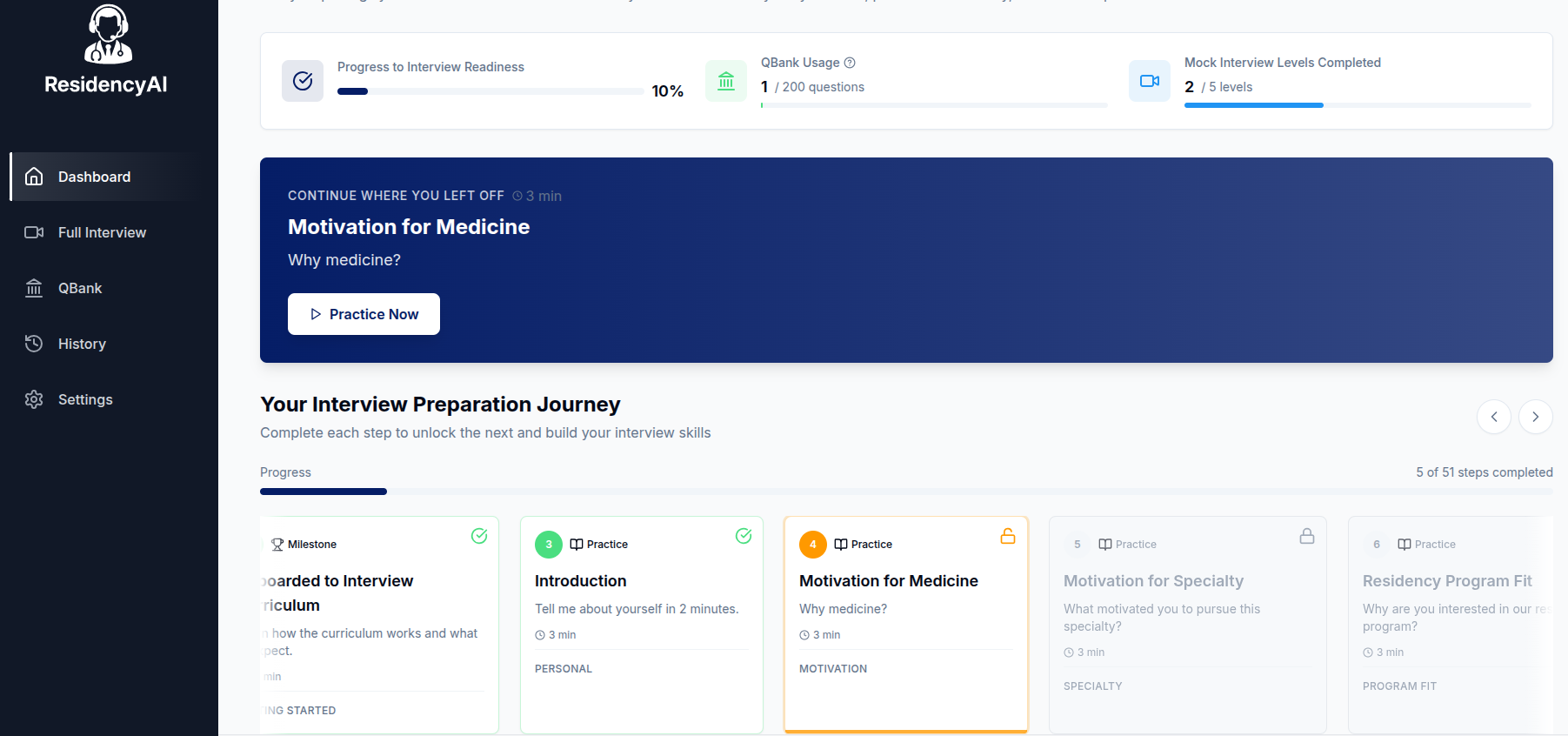
Staring at 200+ questions can feel overwhelming, but consistent, feedback-driven practice turns quantity into confidence. ResidencyAI will act as your personal interview coach, available, to help you practice and refine your answers.
Ready to practice your interview skills?
Try AI-powered mock interviews and get instant, actionable feedback.
| Practice Mode | What It Looks Like | Why It Helps |
|---|---|---|
| Full Mock Interviews | Simulate a 20–30 minute session across a variety of interview scenarios. Find a quiet room and practice as if it were the real thing. | Builds stamina and confidence, and polishes your overall flow. |
| Single-Question Drills | Select any of 200+ questions from the Qbank and tackle them one at a time. | Lets you target weak spots or uncommon questions without running a full interview. |
| Personalized Questions | ResidencyAI reads your personal statement and generates interview questions tailored to your specific experiences and story. | Prepares you for the questions interviewers are most likely to ask which are specific to your application. |
Instant AI Feedback — After each answer, ResidencyAI provides personalized, detailed feedback so you know exactly what to improve.
Personal Statement Review — Beyond interviews, ResidencyAI reviews your personal statement, annotates it, and provides concrete ways to polish it.
Anytime Access — Practice at midnight or on the weekend; no need to coordinate with friends or faculty.
Why It Works
- Personalized analytics for every answer — overall feedback, strengths, areas for improvement.
- Personal statement–driven prep — your interview questions tailored to your personal statement.
- Progress tracking to monitor how ready you are ahead of your interviews.
- 24/7 availability for stress-free, on-demand practice — no scheduling, just practice whenever you want.
- Affordable price compared to other services.
Practicing with a friend or in front of the mirror can build some confidence — but ResidencyAI goes further: it reviews the personal statement that got you the interview, generates questions built specifically around it, and gives you detailed feedback on every answer. When interview day comes, you'll feel like you've been there, done that.