Top 10 Medical School Interview Questions and How to Answer Them
Table of contents
- What They Actually Want
- 1. "Tell me about yourself"
- 2. "Why are you interested in a career in Medicine?"
- 3. "Why are you interested in our medical school?"
- 4. "What are your long-term career goals?"
- 5. "What are your greatest strengths?"
- 6. "Tell me about your weaknesses and how you try to improve them."
- 7. "What do you consider the most challenging part of medical school?"
- 8. "Tell me about a time you worked in a team."
- 9. "Tell me about a time you had to overcome a challenge."
- 10. "Tell me about your leadership abilities."
- Conquering the MMI: Ethical Dilemmas
- Common Pitfalls to Avoid
- Practice With ResidencyAI
- Why It Works
- Read Also
If you’ve survived the grueling AMCAS, AACOMAS, or TMDSAS application cycles, you have reached the final hurdle: the medical school interview.
The stakes are undeniably high. While over 50,000 students apply to allopathic medical schools annually, only roughly 42% successfully matriculate. A pristine GPA and a top-tier MCAT score only get your foot in the door. It is your interview performance that ultimately secures your white coat.
This guide breaks down the core prompts, the frameworks you need to answer them, and how ResidencyAI can help you build the conversational muscle memory to succeed.
What They Actually Want
Interviewers aren’t trying to trick you. They are assessing your self-awareness, communication skills, and readiness for clinical practice against the AAMC's 17 Core Competencies.
Instead of treating these as a checklist, think of them in three broad categories:
- Professional & Interpersonal: Empathy, cultural humility, teamwork, and resilience.
- Thinking & Reasoning: Critical thinking, logical structure, and avoiding the urge to ramble.
- Science & Foundational: Generally established by your transcript, but tested indirectly when you discuss clinical research.
Traditional vs. MMI Formats
Your strategy must adapt to the school's format. Traditional, conversational interviews focus on your overarching narrative and cultural fit. In contrast, the Multiple Mini Interview (MMI) consists of 6 to 10 short, timed ethical scenarios. If your target school requires an MMI or a situational judgment test like CASPer, timed scenario drills are non-negotiable.
1. "Tell me about yourself"
Why they ask: To break the ice, check your narrative cohesion, and establish conversational threads for the rest of the interview.
How to answer: Never wing this. Keep it between 90–120 seconds using the CAMP Method:
- Clinical: Summarize early exposure to prove grounded interest.
- Academic: Highlight intellectual curiosity or research.
- Management: Demonstrate initiative, teamwork, or leadership.
- Personal: End with a hobby to humanize your application.
2. "Why are you interested in a career in Medicine?"
Why they ask: To filter out candidates pursuing medicine for prestige, money, or family pressure. They need to see intrinsic, tested motivation.
How to answer: Avoid the generic "I love science and helping people" trap. Structure your narrative chronologically:
- The Spark: The specific moment that drew you to the intersection of science and humanism.
- The Confirmation: A longitudinal, hands-on clinical experience (e.g., EMT, scribe) that tested your resolve.
- The Excitement: What specifically excites you about the physician’s unique role (e.g., complex diagnostics, leading interdisciplinary teams).
3. "Why are you interested in our medical school?"
Why they ask: Schools protect their yield rates. They want to ensure their program is a top choice, and that your career goals align with their specific mission (e.g., rural primary care vs. urban research).
How to answer: Use the Alignment Strategy. Map your past experiences directly to specific, named programs at the institution.
- Before the interview: Make sure your application narrative matches your answer. Use ResidencyAI’s Personal Statement Reviewer to get section-by-section feedback and ensure a cohesive story across your written and verbal answers.
- In the interview: Name specific curricular tracks or research pathways, and link them to your established passions.
4. "What are your long-term career goals?"
Why they ask: They know you might change your specialty, but they want to see if you possess a realistic vision for the future.
How to answer: State a clear 10-year destination, outline the steps required, and explain how this specific medical school facilitates that path. Mentioning lifestyle or money as your primary driver is an instant red flag.
5. "What are your greatest strengths?"
Why they ask: To evaluate your self-awareness and see if you possess character traits that translate directly to clinical excellence.
How to answer: Focus on one or two specific traits. Use the Claim, Evidence, Clinical Link method.
Example: State you are calm under pressure (Claim), prove it with an EMT anecdote (Evidence), and explain how this will make you a stabilizing force on the wards (Clinical Link).
6. "Tell me about your weaknesses and how you try to improve them."
Why they ask: To assess your capacity for reflective practice and continuous growth. Disguising a strength as a weakness ("I care too much") signals a severe lack of maturity.
How to answer:
- Problem: Identify a genuine, relatable weakness (e.g. delegating tasks).
- Action: Detail the concrete, proactive steps taken to correct it.
- Consequence: Highlight the positive outcome of your actions.
- Evaluation: Acknowledge that growth is an ongoing, lifelong process.
Tip: This is one of the hardest questions to nail. Rehearse your response using ResidencyAI’s Single Question practice mode to perfect your tone and receive immediate, targeted feedback.
7. "What do you consider the most challenging part of medical school?"
Why they ask: To guarantee you aren't wearing rose-colored glasses regarding the emotional and academic toll of medical training.
How to answer: Acknowledge a systemic challenge (like burnout or maintaining personal identity), normalize it, and present a proven mitigation strategy based on your past (e.g., aggressive time management and protecting time for hobbies).
8. "Tell me about a time you worked in a team."
Why they ask: Modern medicine is highly interdisciplinary. You must be able to collaborate seamlessly without letting ego get in the way.
How to answer: Use the STAR-L Method:
- Situation (15%): Set the scene.
- Task (10%): Define the specific problem.
- Action (60%): Detail the precise steps you took to foster collaboration, listen actively, and resolve conflict.
- Result (10%): Explain the positive outcome.
- Lesson (5%): Connect it to your future growth as a physician.
9. "Tell me about a time you had to overcome a challenge."
Why they ask: To evaluate your emotional regulation and resilience. Medical training will inevitably induce setbacks.
How to answer: Emphasize the pivot. The challenge itself (e.g., a poor grade, a financial hurdle) matters far less than your internal realization, your willingness to ask for help, and the actionable, mature strategies you implemented to succeed.
10. "Tell me about your leadership abilities."
Why they ask: Physicians are de facto leaders, but effective clinical leadership requires psychological safety and mentorship, not just barking orders.
How to answer: Focus on Servant Leadership. Frame your STAR-L response around how you empowered others, facilitated collaboration, and actively listened, rather than just highlighting a title you held.
Conquering the MMI: Ethical Dilemmas
If you are facing a Multiple Mini Interview, you must "Show Your Work" by expressing your thought process out loud. A strong MMI response relies on the Four Pillars of Bioethics:
- Autonomy: Respecting the patient's right to decide.
- Beneficence: Acting in the patient’s best interest.
- Nonmaleficence: Doing no harm.
- Justice: Equitable distribution of resources.
Don't rush to a rigid "yes" or "no." Instead: gather information, explore all perspectives, and deliver a nuanced conclusion that weighs these bioethical pillars against one another.
Common Pitfalls to Avoid
- Reciting Your CV: They already read it. Focus on impact and lessons learned.
- Poor Time Management: Keep traditional answers to 1–2 minutes.
- Skipping the Human Touch: Personal hobbies make you memorable. You can easily use them to pivot into "Why our school?".
- The "Robotic" Rehearsal: Memorize your frameworks, not a script. Sounding like a teleprompter kills authenticity.
Practice With ResidencyAI
Staring at 200+ questions can feel overwhelming, but consistent, feedback-driven practice turns quantity into confidence. ResidencyAI will act as your personal interview coach, available, to help you practice and refine your answers.
Ready to practice your interview skills?
Try AI-powered mock interviews and get instant, actionable feedback.
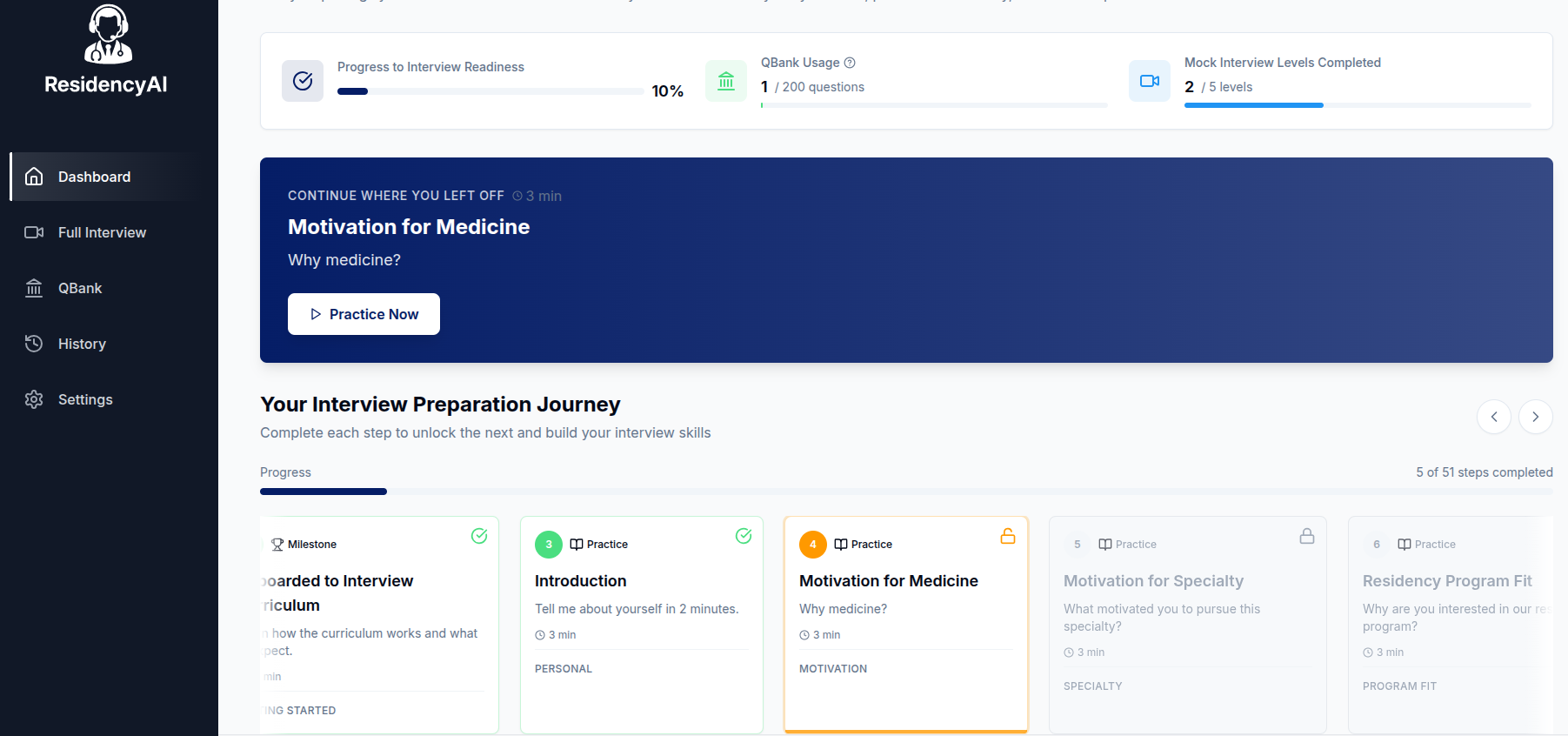
| Practice Mode | What It Looks Like | Why It Helps |
|---|---|---|
| Full Mock Interviews | Simulate a 20–30 minute session across a variety of interview scenarios. Find a quiet room and practice as if it were the real thing. | Builds stamina and confidence, and polishes your overall flow. |
| Single-Question Drills | Select any of 200+ questions from the Qbank and tackle them one at a time. | Lets you target weak spots or uncommon questions without running a full interview. |
| Personalized Questions | ResidencyAI reads your personal statement and generates interview questions tailored to your specific experiences and story. | Prepares you for the questions interviewers are most likely to ask which are specific to your application. |
Instant AI Feedback — After each answer, ResidencyAI provides personalized, detailed feedback so you know exactly what to improve.
Personal Statement Review — Beyond interviews, ResidencyAI reviews your personal statement, annotates it, and provides concrete ways to polish it.
Anytime Access — Practice at midnight or on the weekend; no need to coordinate with friends or faculty.
Why It Works
- Personalized analytics for every answer — overall feedback, strengths, areas for improvement.
- Personal statement–driven prep — your interview questions tailored to your personal statement.
- Progress tracking to monitor how ready you are ahead of your interviews.
- 24/7 availability for stress-free, on-demand practice — no scheduling, just practice whenever you want.
- Affordable price compared to other services.
Practicing with a friend or in front of the mirror can build some confidence — but ResidencyAI goes further: it reviews the personal statement that got you the interview, generates questions built specifically around it, and gives you detailed feedback on every answer. When interview day comes, you'll feel like you've been there, done that.