How to Answer Tell Me About Yourself in a Medical School Interview
Table of contents
Medical school interviews rarely surprise well-prepared candidates. If you've survived the grueling AMCAS, AACOMAS, or TMDSAS application cycles, the interview is your final hurdle. By preparing for the core prompts in advance, you can spend your interview building genuine rapport rather than scrambling for answers.
This post breaks down the most universally asked, yet frequently mishandled, question in the admissions process: “Tell me about yourself.” We’ll cover why committees ask it, the best structural frameworks to use, and how mastering medical school interviews can elevate your entire application.
1. The Psychology: Why Do They Ask It?
Before drafting your response, you need to understand the psychology of medical interviews. Interviewers aren't trying to trick you; they are assessing your self-awareness and communication skills.
According to every complete preparation guide, admissions committees use this prompt to accomplish three things:
- Break the Ice: Interviews are stressful. Starting with a broad question about the topic you know best—your own life—sets a conversational tone.
- Check Your Narrative: They already have your GPA and MCAT scores. This isn't an oral resume; it’s a test of what you prioritize when given an open floor.
- Establish Conversational Threads: A strategic answer gives the interviewer "threads" to pull. Mentioning a unique hobby or a specific research project frames the rest of the interview around topics you want to discuss.
2. Frameworks for Success: The CAMP Method
The biggest mistake candidates make is "winging" this question, resulting in a rambling, chronological mess. To keep your answer tight (aim for 90 to 120 seconds), experts recommend using structural interview techniques.
The gold standard is the CAMP framework:
| CAMP Pillar | Objective | Example Snippet |
|---|---|---|
| Clinical | Summarize early clinical exposure to prove your interest is grounded in reality. | "During my junior year, I volunteered as a medical scribe in an urban Level 1 trauma center..." |
| Academic | Highlight intellectual curiosity, research, or teaching roles. | "...This exposure drove me to pursue independent research analyzing ER wait times..." |
| Management | Demonstrate initiative, teamwork, and leadership capability. | "...Outside the lab, I served as president of our pre-health society, managing a team of six..." |
| Personal | End with a hobby to humanize your application and build rapport. | "...To stay grounded, I am an avid rock climber and teach youth climbing clinics." |
3. Deconstructing Answers: Poor vs. Exceptional
To truly understand these medical interview tips and tricks, let’s look at how narrative building works in practice.
❌ The Poor Response
"Um, okay, so I was born in New Jersey. I always wanted to be a doctor since I was little. I went to college in Boston. In undergrad, I liked all my science classes and I shadowed a bit. I want to help people. I also play guitar. Your medical school seems really nice, and I hope I get in."
Why it fails: It relies on generic clichés ("want to help people") that apply to every applicant. It lacks narrative cohesion, highlights zero rigorous clinical exposure, and ends on a passive note.
🌟 The Exceptional Response
"I grew up in New Jersey and went to undergrad in Boston, where I majored in neuroscience. Living in a major city exposed me to a wonderfully diverse patient population when I began volunteering as a medical interpreter at a community free clinic. That experience truly fueled my passion for direct patient advocacy. Along the way, I got involved in a public health research project analyzing healthcare disparities, which taught me how much I enjoy answering complex clinical questions. I also served as my pre-med society’s community outreach chair, which honed my leadership skills. Outside of academia, I’m an avid runner and have completed two marathons—training taught me immense resilience. Ultimately, these experiences have shaped me into someone who thrives on continuous learning, which is why I’m so thrilled to be interviewing here today."
Why it succeeds: It's a masterful application of CAMP. It establishes origins, moves to a highly specific clinical spark, highlights intellectual curiosity and leadership, and concludes with a memorable personal trait. For more audio-visual breakdowns, watch these video examples of strong answers.
4. Common Pitfalls to Avoid
Even candidates with pristine applications can stumble. As you review the ultimate guide to getting into medical school, keep these common mistakes in mind:
- Reciting your CV: Admissions committees already read your AMCAS. Highlight just two or three defining experiences, focusing on impact and lessons learned.
- Poor Time Management: Keep it between 60 and 120 seconds. Rambling cuts into the time allocated for behavioral follow-ups.
- Skipping the Human Touch: Don't just talk about organic chemistry. Mentioning hobbies shows you have healthy outlets for stress. You can also use this personal touch to pivot into connecting your answer to 'Why This Medical School?'.
- The "Robotic" Rehearsal: Memorize your CAMP bullet points, not a word-for-word script. Sounding like you are reading from a teleprompter kills your authenticity.
5. Adapting to Interview Formats (Traditional vs. MMI)
Your strategy must shift depending on the interview format.
Traditional Panel Interviews (30–60 minutes) Institutions like Sidney Kimmel Medical College and the Lewis Katz School of Medicine at Temple University use traditional, conversational interviews. Here, "Tell me about yourself" is the ultimate ice-breaker. Use your full 90-to-120-second CAMP framework to set the agenda for the next half hour.
Multiple Mini Interviews (MMI) Conversely, schools like Drexel University College of Medicine utilize the MMI format. According to the Multiple Mini Interview (MMI) procedures outlined by the AAMC, an MMI consists of 6 to 10 short stations (6–8 minutes each). If you face an ice-breaker station here, compress your introduction to 60–75 seconds so the rater has time for their standardized follow-up questions.
Practice With ResidencyAI
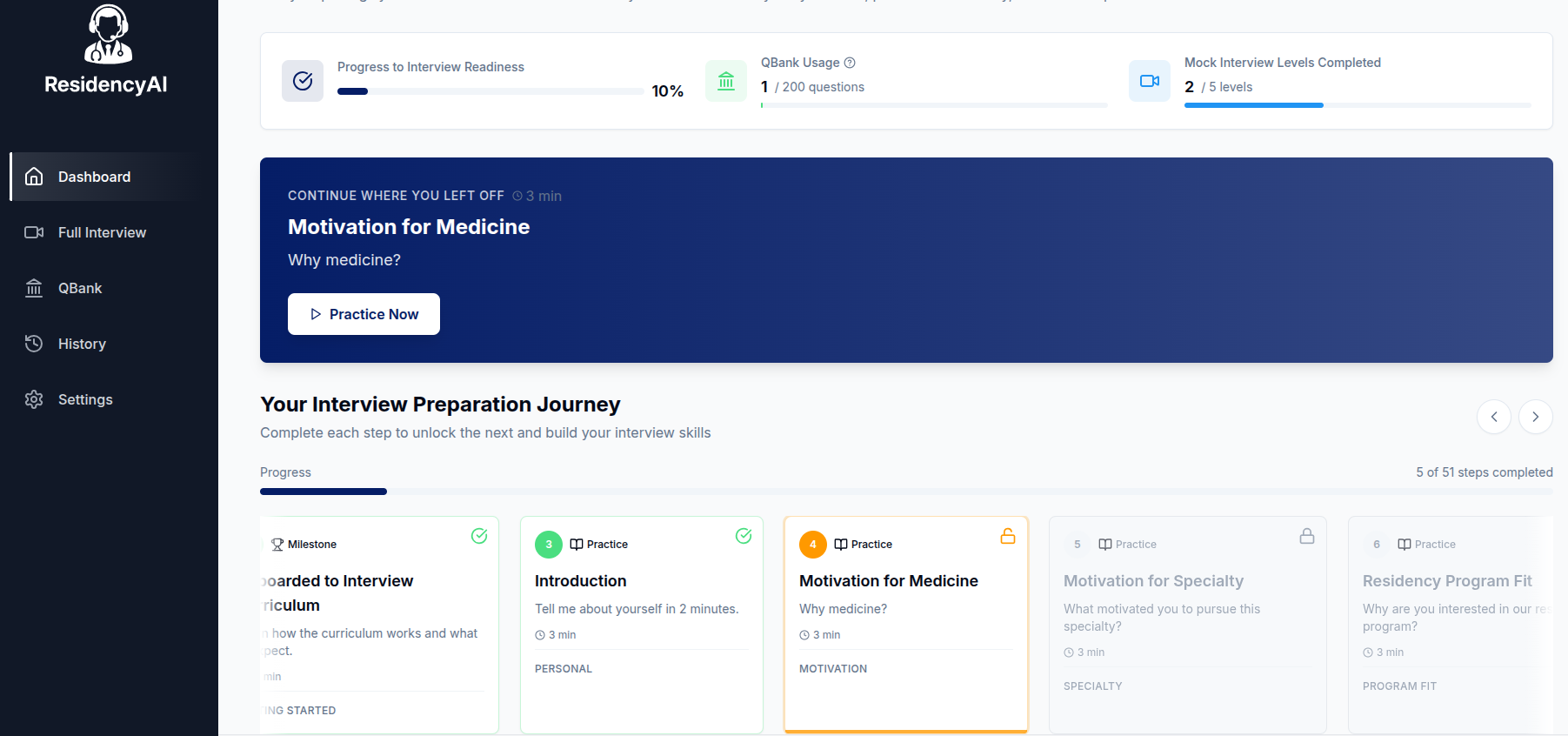
Staring at 200+ questions can feel overwhelming, but consistent, feedback-driven practice turns quantity into confidence. ResidencyAI will act as your personal interview coach, available, to help you practice and refine your answers.
Ready to practice your interview skills?
Try AI-powered mock interviews and get instant, actionable feedback.
| Practice Mode | What It Looks Like | Why It Helps |
|---|---|---|
| Full Mock Interviews | Simulate a 20–30 minute session across a variety of interview scenarios. Find a quiet room and practice as if it were the real thing. | Builds stamina and confidence, and polishes your overall flow. |
| Single-Question Drills | Select any of 200+ questions from the Qbank and tackle them one at a time. | Lets you target weak spots or uncommon questions without running a full interview. |
| Personalized Questions | ResidencyAI reads your personal statement and generates interview questions tailored to your specific experiences and story. | Prepares you for the questions interviewers are most likely to ask which are specific to your application. |
Instant AI Feedback — After each answer, ResidencyAI provides personalized, detailed feedback so you know exactly what to improve.
Personal Statement Review — Beyond interviews, ResidencyAI reviews your personal statement, annotates it, and provides concrete ways to polish it.
Anytime Access — Practice at midnight or on the weekend; no need to coordinate with friends or faculty.
Why It Works
- Personalized analytics for every answer — overall feedback, strengths, areas for improvement.
- Personal statement–driven prep — your interview questions tailored to your personal statement.
- Progress tracking to monitor how ready you are ahead of your interviews.
- 24/7 availability for stress-free, on-demand practice — no scheduling, just practice whenever you want.
- Affordable price compared to other services.
Practicing with a friend or in front of the mirror can build some confidence — but ResidencyAI goes further: it reviews the personal statement that got you the interview, generates questions built specifically around it, and gives you detailed feedback on every answer. When interview day comes, you'll feel like you've been there, done that.