How to Answer Behavioral Questions in Medical School Interviews
Table of contents
By the interview stage, candidates have already proven their academic ability by completing the AMCAS, AACOMAS, or TMDSAS application process. The interview is the final hurdle, and mastering behavioral questions ("Tell me about a time when...") lets candidates focus on building rapport rather than scrambling for answers. This section promises a breakdown of how to structure and deliver strong responses to these heavily weighted questions.
1. The Psychology Behind the Prompt
Interviewers use evidence-based assessment frameworks to evaluate a candidate's self-awareness, maturity, and communication skills — not to trick them. The AAMC prioritizes behavioral questions because past behavior is the most reliable predictor of future behavior, so interviewers favor concrete historical examples over hypothetical "what would you do" questions. A structured, articulate answer early in the interview builds credibility and trust that carries through the rest of the conversation.
2. Mapping Your Stories to AAMC Core Competencies
A winning interview strategy requires mapping your past experiences to the exact traits medical schools are looking for. While the AAMC lists 17 Premed Competencies, behavioral questions heavily target your professional and interpersonal skills:
- Resilience: "Tell me about a time when you experienced a significant academic setback." Proves you can recover from stress and balance well-being.
- Teamwork: "Describe a time you faced an obstacle on a group project." Verifies you prioritize shared goals over ego.
- Cultural Humility: "Tell me about a time you built a relationship with someone from a different background." Shows you engage openly with differing viewpoints.
- Ethical Responsibility: "Describe a time you observed a peer behaving inconsistently with protocols." Tests your integrity under pressure.
- Interpersonal Skills: "Tell me about a time you experienced a conflict with a coworker." Assesses emotional regulation and respect.
3. The STAR-L Framework: Structuring Your Answer
The most common mistake applicants make is "winging it," which inevitably results in a rambling, chronological mess. To keep your answers tight—ideally between 90 and 120 seconds—you need a reliable structural framework.
The gold standard in medical advising is the STAR-L method:
- Situation (20%): Briefly set the scene, the context, and the stakes.
- Task (10%): State your specific responsibility or goal.
- Action (60%): Detail the precise steps you took. Use strong "I" statements to highlight your direct problem-solving skills.
- Result (10%): Share the outcome, quantifying the impact whenever possible.
- Learning (Crucial): Reflect on what the experience taught you and how it translates to a career in medicine. Skipping this step is a massive missed opportunity to show maturity.
Tip: Memorizing a framework is one thing; executing it naturally is another. Using a targeted single-question practice mode allows you to repeatedly drill these structural percentages until the pacing becomes second nature without sounding rehearsed.
4. Handling Conflict: The CARER Method
Conflict resolution questions rank high among common interview stumbling blocks. The intention isn't to hear you complain, but to see how you maintain composure under pressure.
To avoid the trap of blaming the other party, utilize a specialized variation of STAR-L known as the CARER method:
- Context: The background of the situation.
- Action of the other person: What they did (stated objectively, without judgment).
- Response: Your constructive, proactive actions.
- Effect: The quantifiable outcome.
- Reflection: The clinical or professional lesson learned.
Instead of saying you "avoided a toxic attending," describe how you gathered objective data to propose a compromise that satisfied the attending's efficiency metrics while prioritizing patient care. This proves you know how to respectfully challenge authority for patient safety.
5. Discussing Failures Authentically
When asked about your greatest weakness or a past failure, avoid the humblebrag (e.g., "I work too hard" or "I care too much"). Admissions committees view these fake failures as insecure and inauthentic.
Instead, offer a genuine mistake. Take full accountability without blaming the environment, and dedicate the bulk of your answer to the "Learning" phase. Highlighting a concrete corrective action—like enrolling in a medical Spanish course after failing to anticipate a linguistic risk—is far more compelling than pretending to be perfect.
6. Common Pitfalls to Avoid
Even highly competitive applicants with pristine stats stumble on behavioral interviews. Keep these common errors in check:
- The "We" vs. "I" Dilemma: Saying "we researched" or "we presented" obscures your individual contribution. Own your actions.
- The Oral Resume: Don't recite your CV. They’ve already read it. Deep dive into a specific micro-narrative.
- Robotic Rehearsal: Memorize your structure (your story's trail markers), not a word-for-word script.
- Poor Time Management: Don't spend 80% of your time explaining the backstory. Get to the Action and Learning phases quickly.
Practice With ResidencyAI
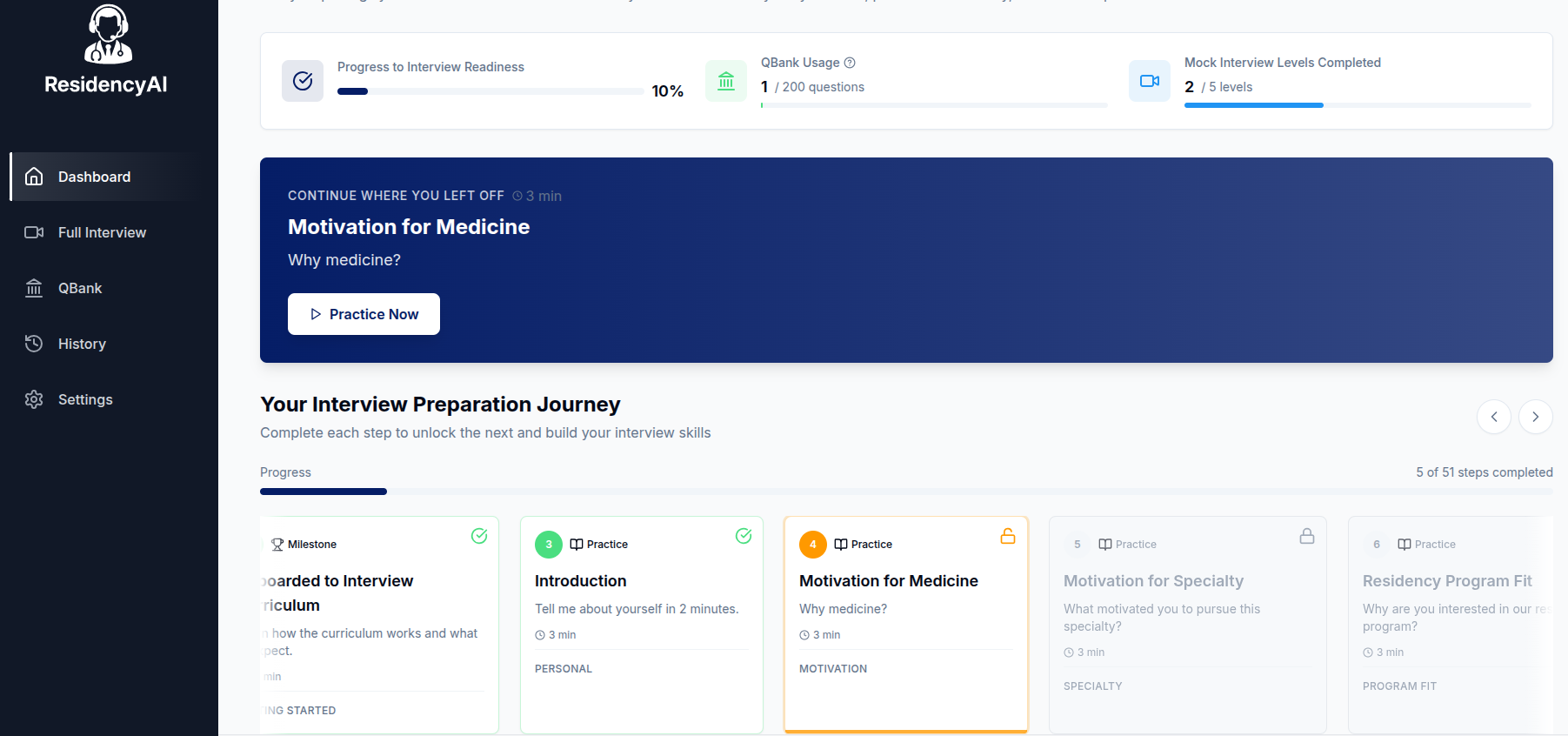
Staring at 200+ questions can feel overwhelming, but consistent, feedback-driven practice turns quantity into confidence. ResidencyAI will act as your personal interview coach, available, to help you practice and refine your answers.
Ready to practice your interview skills?
Try AI-powered mock interviews and get instant, actionable feedback.
| Practice Mode | What It Looks Like | Why It Helps |
|---|---|---|
| Full Mock Interviews | Simulate a 20–30 minute session across a variety of interview scenarios. Find a quiet room and practice as if it were the real thing. | Builds stamina and confidence, and polishes your overall flow. |
| Single-Question Drills | Select any of 200+ questions from the Qbank and tackle them one at a time. | Lets you target weak spots or uncommon questions without running a full interview. |
| Personalized Questions | ResidencyAI reads your personal statement and generates interview questions tailored to your specific experiences and story. | Prepares you for the questions interviewers are most likely to ask which are specific to your application. |
Instant AI Feedback — After each answer, ResidencyAI provides personalized, detailed feedback so you know exactly what to improve.
Personal Statement Review — Beyond interviews, ResidencyAI reviews your personal statement, annotates it, and provides concrete ways to polish it.
Anytime Access — Practice at midnight or on the weekend; no need to coordinate with friends or faculty.
Why It Works
- Personalized analytics for every answer — overall feedback, strengths, areas for improvement.
- Personal statement–driven prep — your interview questions tailored to your personal statement.
- Progress tracking to monitor how ready you are ahead of your interviews.
- 24/7 availability for stress-free, on-demand practice — no scheduling, just practice whenever you want.
- Affordable price compared to other services.
Practicing with a friend or in front of the mirror can build some confidence — but ResidencyAI goes further: it reviews the personal statement that got you the interview, generates questions built specifically around it, and gives you detailed feedback on every answer. When interview day comes, you'll feel like you've been there, done that.