How to Write a Medical School Personal Statement (2026)
Table of contents
- Section 1 — What the essay is actually for
- Section 2 — The invisible rubric readers use
- Section 3 — The shape of a strong essay
- Section 4 — How to open strong
- Section 5 — Craft-level fixes that matter most
- Section 6 — Pick your narrative, don't force one
- Section 7 — Red flags to self-edit for
- Section 8 — A self-grading checklist
- Practice With ResidencyAI
- Why It Works
- Read Also
If you take away one thing from this guide, take this: your medical school personal statement is not there to prove you're qualified — your GPA and MCAT already did that — it's there to prove you understand what you're actually signing up for. The single question every strong essay answers is not "why healthcare" or "why helping people," but why medicine, specifically. This is the highest-leverage 5,300 characters in your entire application, and these medical school personal statement tips will show you how to use every one of them.
A quick reality check on the stakes. According to the AAMC's 2025 report, Medical School Enrollment Reaches 100,000 Students for the First Time, 54,699 people applied to U.S. MD programs — a 5.3% jump, the largest gain since 2015-16 — competing for an incoming class of 23,440 first-year seats. Your reader is a tired human being — a physician, scientist, or admissions dean — working through a tall stack of essays that mostly sound alike. Your job is to be the one that reads like a person who has thought hard about this path.
Quick answer: The personal statement's job is to show insight, not credentials. Open in a real scene, spend most of your characters reflecting rather than narrating, answer "why medicine, specifically," and cut anything that could appear word-for-word in someone else's essay.
Section 1 — What the essay is actually for
Here's the reframe that changes everything. Most applicants approach the personal statement as a closing argument: here is all the evidence that I am impressive. But the numbers-based case for you already lives in your transcript, your MCAT score, and your Work and Activities section. Re-litigating it in prose wastes the one place in the application where you get to be a human being.
The essay's real purpose is to demonstrate that you know what medicine is — its tedium, its emotional weight, its limits — and that you're choosing it anyway with your eyes open. As the AAMC's advisor guidance on crafting your personal statement frames it, the personal comments essay is your chance to convey "why you want to go to medical school," and the prehealth advisors the AAMC interviewed describe it as an essay that lives "between a reflective, analytical narrative and an argumentative essay."
To be clear about the genre, here's what the personal statement is NOT:
- A résumé in prose. If a sentence just re-lists an activity already in your application, it's dead weight.
- An autobiography. You are not obligated to start at birth or cover everything. Pick a thread.
- A specialty declaration. You don't need to announce you're destined for pediatric neurosurgery. You're applying to medical school, not to a residency.
Section 2 — The invisible rubric readers use
Admissions committees practice "holistic review," and the scaffolding underneath it is the AAMC's premed competencies — a set that grew from 15 attributes in 2011 to 17 in the 2022–2023 update, with two titles refreshed again in 2026 (what used to be "cultural humility" is now self-awareness, and "cultural awareness" is now understanding others). You do not need to memorize all of them, and you should absolutely not name-drop them in your essay.
What matters is that readers scan for a handful of these qualities shown through scenes, not asserted. If you write "I am empathetic and a strong team player," you've demonstrated neither. If you show yourself sitting with a scared patient or absorbing hard feedback from a supervisor, the reader concludes it themselves — which is far more persuasive.
The competencies that surface most often in a strong "why medicine" essay are:
- Empathy and compassion — recognizing and responding to others' distress.
- Self-awareness — reflecting on your assumptions and revising your thinking.
- Service orientation — commitment to something larger than yourself.
- Commitment to learning and growth — reflecting on setbacks and seeking feedback.
- Ethical responsibility to self and others — honesty, integrity, humility about your role.
Notice that all five are interpersonal or intrapersonal, not academic. That's the tell. The essay is where you prove the human competencies your MCAT can't measure.
Section 3 — The shape of a strong essay
Forget five-paragraph-theme structure. A personal statement is an argument delivered through story. A simple structure I call REFLECT keeps you honest:
- Real scene — drop the reader into a specific moment.
- Experiences — two or three that build a pattern, not a list.
- Feeling and Learning — what shifted in how you think.
- Evolution — how your understanding of medicine matured.
- Connection — why this leads specifically to being a physician.
- Trajectory — a forward look at the doctor you're becoming.
Because you have only 5,300 characters (roughly 750–850 words) on the AMCAS application — and 5,000 on TMDSAS — proportion matters more than any single sentence. Here's a working character-allocation map. Treat it as a budget, not a straitjacket:
| Section | Job | Approx. share | Characters (of ~5,300) |
|---|---|---|---|
| Hook / opening scene | Drop reader into a real moment | ~10% | ~530 |
| Clinical / core experience | Ground your motivation in reality | ~25% | ~1,325 |
| Formative experiences | Build a pattern of evidence | ~25% | ~1,325 |
| Synthesis / reflection | Show insight and growth | ~25% | ~1,325 |
| Forward look | Connect to your future as a physician | ~10% | ~530 |
| Closing | Land the theme; callback to the hook | ~5% | ~265 |
The biggest correction most drafts need: the reflection block is too small. Description is cheap; insight is what readers are buying.
Condensed worked example (original, fictional — a career-changer). Notice how little space the prior career gets and how much goes to reflection:
For six years I optimized supply chains, and I was good at it. The spreadsheet that finally changed my life wasn't one of mine — it was the medication list a hospice nurse handed me the week my father was dying, walking me through each line until the fear in the room lowered by a degree. I had spent my career making systems efficient. She was doing something I couldn't quantify: making a terrified family feel less alone. [...] Volunteering in a free clinic since then hasn't romanticized any of this for me — I've watched us fail to fix problems that were never medical to begin with. What pulls me toward medicine isn't the fantasy of rescue. It's wanting the specific competence she had: to be the person who can both read the chart and lower the fear in the room.
That's a career-changer answering "why medicine, and why now" without spending two-thirds of the essay apologizing for the switch — the single most common career-changer mistake.
After revising the structure yourself, use ResidencyAI to review and annotate your personal statement and identify passages that could be more specific.
Section 4 — How to open strong
Your first sentence is the only one guaranteed a read. Four opening patterns that reliably work:
- In-scene action. The suture kit trembled because my hands did, not because the mannequin cared.
- A line of dialogue. "Are you going to remember me?" she asked, and I realized I didn't know the honest answer.
- A reversal of expectation. I became more sure about medicine the day a patient told me I'd gotten it wrong.
- A concrete, surprising object or detail. There was a jar of buttons on the dialysis unit's windowsill, and every one of them had a story.
Then apply the "delete the first sentence" test: cut your opening line and see if the paragraph is stronger without it. Warm-up throat-clearing ("Medicine is a noble and demanding profession...") almost always dies here, and the essay is better for it. Writers often find their real hook was the second or third sentence all along.
Openings to avoid (readers have seen each of these thousands of times):
- "Ever since I was a child, I have wanted to be a doctor."
- "Webster's Dictionary defines compassion as..."
- A famous quotation from Gandhi, Einstein, or Mother Teresa.
- "I have always loved science and wanted to help people."
- A high-drama patient-crash cold-open where you're a bystander ("The monitor beeped as her blood pressure plummeted...").
Hyper-dramatic openings tend to distract from substance rather than add it, and childhood-destiny framing rarely signals informed commitment — readers care far more about when you understood the realities of medicine than about how long you've been interested.
Section 5 — Craft-level fixes that matter most
A few high-yield moves separate a good draft from a memorable one.
Show, don't tell. "Showing" costs more words but earns more trust, because it lets the reader draw their own conclusion. Don't state the quality — stage the moment that proves it.
The swap test for specificity. Read each sentence and ask: would this work, unchanged, in ten thousand other applicants' essays? If yes, it's not pulling its weight. As JackWestin's 2026 personal statement guide puts it, "if a sentence could be copied into 10,000 other essays without changing a word, it is probably not doing enough work." Specificity is what makes you memorable.
Watch your reflection-to-narration ratio. A common failure mode is treating experiences as self-evident proof of a career choice — vivid story, zero insight. Aim to spend at least as many characters on what an experience taught you as on what happened.
Authentic voice vs. "thesaurus voice." Reaching for the fanciest synonym makes you sound like everyone else who reached for it. Clear, direct language reads as more mature, not less.
Three before/after pairs (all original):
Savior complex. Before: "I knew I could be the one to save patients who had no one else." After: "I couldn't fix her housing or her insurance, but I could make sure she understood her discharge instructions in her own language — and I started to see how much of medicine lives in those small, unglamorous acts."
Activity-list dump. Before: "I volunteered at the free clinic, shadowed in cardiology, tutored underserved students, and conducted research on inflammation." After: "The free clinic taught me to ask better questions; cardiology taught me to sit with uncertainty when the answer wasn't on the monitor."
Thesaurus voice. Before: "My indefatigable ardor for the medical vocation was irrevocably solidified during my tenure as a volunteer." After: "Volunteering didn't spark my interest in medicine — it stress-tested it, and it held."
Section 6 — Pick your narrative, don't force one
There is no required plot. Strong essays come in many shapes, and the "aha moment" is largely a myth: Shemmassian Academic Consulting's analysis reports that only about 10 percent of students had a single moment where they knew they wanted to be a doctor and never looked back — the other 90 percent built their conviction gradually. Fabricating a cinematic epiphany usually reads as forced.
Five archetypes that work, so you can find the one that fits your real story:
- The patient interaction — a specific relationship that reframed what care means.
- The personal challenge — an illness, loss, or hardship, written for what you learned, not for sympathy.
- The research-driven path — curiosity about mechanism that pulled you toward patients.
- The community-impact story — service that exposed how medicine and inequity intersect.
- The gradual realization — no lightning bolt, just accumulating evidence that this is the only path that fits.
If you don't have a dramatic origin story, good. Most people don't. Reflection beats spectacle every time.
Section 7 — Red flags to self-edit for
Run a dedicated editing pass looking only for these. This isn't a scolding — it's the same triage a reader does, done by you first:
- Savior complex. Any hint that you single-handedly rescued someone undermines the humility readers prize. Reframe toward what you learned.
- Premature specialty declaration. Committing to a specialty can read as naïve. Stay open.
- Résumé dump. Cut anything that merely repeats your Work and Activities list.
- Cliché phrases. "I want to help people," "for as long as I can remember," "I want to make a difference." If it's universal, it's invisible.
- Real patient names / HIPAA concerns. Never use a real patient's name or identifying details. Use a changed first name or an initial; a brief "(name changed)" is fine. The identifiers that actually matter here are names, specific dates, and pinpoint locations — strip them.
- Unused character space. Coming in dramatically under the limit signals you had less to say. Use the room — without padding.
Section 8 — A self-grading checklist
Before you submit, read your essay out loud and check each box honestly:
- Does my opening drop the reader into a real moment (no throat-clearing)?
- Have I answered "why medicine, specifically" — not "why helping people"?
- Do I spend at least as many characters reflecting as narrating?
- Would any sentence survive the swap test — is it unmistakably mine?
- Have I shown the human competencies (empathy, self-awareness, service) instead of naming them?
- Did I remove savior-complex phrasing and any premature specialty lock-in?
- Is every patient detail HIPAA-safe?
- Does it sound like me read aloud — not like a thesaurus?
- Is it proofread? (AMCAS has no spell-check, and you can't edit after submitting.)
Practice With ResidencyAI
Writing a personal statement by yourself can be very daunting. ResidencyAI can review your personal statement, annotate it and suggest changes that will distinguish it from the crowd. Additionally, ResidencyAI will act as your personal interview coach, available, to help you practice and refine your answers.
Ready to practice your interview skills?
Try AI-powered mock interviews and get instant, actionable feedback.
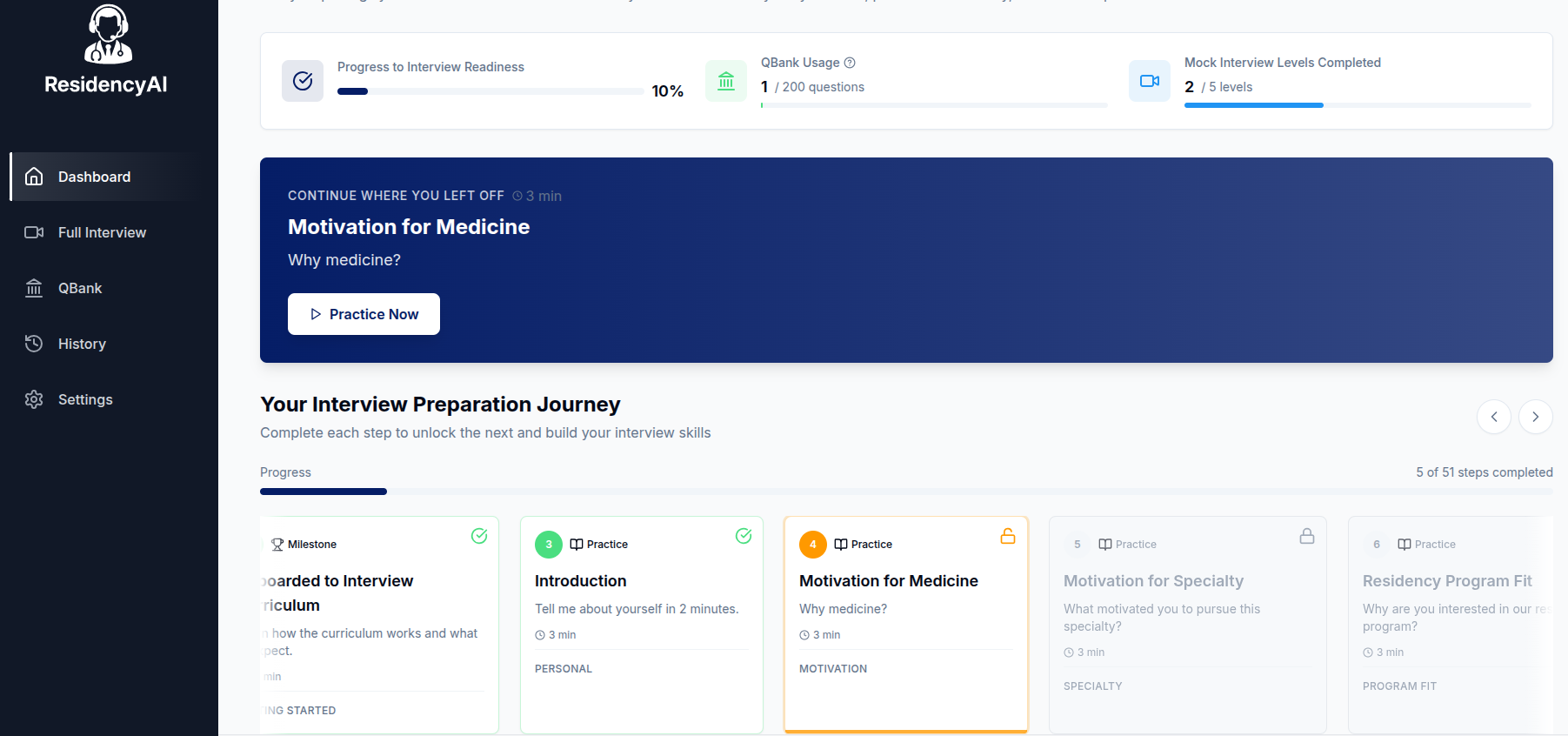
| Practice Mode | What It Looks Like | Why It Helps |
|---|---|---|
| Full Mock Interviews | Simulate a 20–30 minute session across a variety of interview scenarios. Find a quiet room and practice as if it were the real thing. | Builds stamina and confidence, and polishes your overall flow. |
| Single-Question Drills | Select any of 200+ questions from the Qbank and tackle them one at a time. | Lets you target weak spots or uncommon questions without running a full interview. |
| Personalized Questions | ResidencyAI reads your personal statement and generates interview questions tailored to your specific experiences and story. | Prepares you for the questions interviewers are most likely to ask which are specific to your application. |
Instant AI Feedback — After each answer, ResidencyAI provides personalized, detailed feedback so you know exactly what to improve.
Anytime Access — Practice at midnight or on the weekend; no need to coordinate with friends or faculty.
Why It Works
- Personalized analytics for every answer — overall feedback, strengths, areas for improvement.
- Personal statement–driven prep — your interview questions tailored to your personal statement.
- Progress tracking to monitor how ready you are ahead of your interviews.
- 24/7 availability for stress-free, on-demand practice — no scheduling, just practice whenever you want.
- Affordable price compared to other services.
Practicing with a friend or in front of the mirror can build some confidence — but ResidencyAI goes further: it reviews the personal statement that got you the interview, generates questions built specifically around it, and gives you detailed feedback on every answer. When interview day comes, you'll feel like you've been there, done that.