How to Apply to DO Medical Schools (2026–2027 Guide)
Table of contents
- What actually separates DO from MD
- Eligibility and prerequisites
- The AACOMAS application timeline and key dates
- Choosing your schools
- Personal statement essentials for DO applicants
- Secondary applications
- DO interview prep: formats, and the questions that catch people off guard
- Your DO application checklist
- Practice With ResidencyAI
- Read Also
Close to 30% of U.S. medical students now train to become a DO, according to AACOM's 2026 application-cycle report, and that share continues to grow.
This guide covers the whole journey: AACOMAS, prerequisites, choosing schools, essays, secondaries, and interview prep. The short version — apply early, show genuine fit with osteopathic medicine, and start practicing for the interview before the invite lands.
A DO (Doctor of Osteopathic Medicine) is a fully licensed physician. Same rights as an MD (Doctor of Medicine): prescribe, operate, practice any specialty. The difference is philosophy, plus one extra skill — OMM, or osteopathic manipulative medicine. That's hands-on diagnosis and treatment, taught on top of the standard curriculum.
What actually separates DO from MD
DOs and MDs take the same core sciences, the same rotations, and compete in the same residency match. Osteopathic training adds one thing: a whole-person philosophy, summed up in four tenets.
- The body is a unit of body, mind, and spirit.
- The body can self-regulate and self-heal.
- Structure and function are interrelated.
- Treatment should work with all three ideas above, not against them.
That philosophy isn't decoration. It shapes who gets in and what you'll be asked at interview.
The two paths also license differently. DO students take the COMLEX-USA — it tests the same clinical science as the MD exam, plus OMM and osteopathic principles. Many DO students also sit the USMLE, the MD licensing exam, to stay competitive for certain residencies. Know this early: it shapes how you'll answer the inevitable "why DO?"
Bottom line: A DO is a physician, full stop. You're not choosing a lesser path — you're choosing a philosophy of care. Admissions committees can tell within minutes whether you actually believe that.
Eligibility and prerequisites
Your prerequisites look nearly identical to MD requirements:
- One year each of biology, general chemistry, organic chemistry, and physics — most with labs.
- English and math.
- Increasingly, biochemistry.
Most schools want a C or better in each course; many prefer a B or above.
Here's where DO diverges: a letter from an osteopathic physician is strongly recommended, sometimes required. Shadowing a DO is close to essential — schools want proof you understand what you're signing up for.
- Shadowing and clinical hours: requirements vary by school, but expect a floor somewhere between 40 and 100+ hours combined. Check each target school's minimum in AACOM's Choose DO Explorer, the official searchable database.
- Letters of recommendation: commonly a science faculty member plus a physician letter, with a DO strongly preferred. Some schools accept a pre-health committee letter instead — confirm per school.
- Personal qualities: per AACOM's own admissions guidance, schools want demonstrated integrity, resilience, communication skills, and genuine service — not just numbers.
The numbers, per AACOM's own admissions data: 2025 mean GPA 3.62, mean MCAT 502.95 — a notch below MD matriculants (roughly 3.8 GPA, 512 MCAT). Lower stats don't mean an easier bar. DO schools review holistically, so mission fit, service, and clinical exposure carry real weight.
The AACOMAS application timeline and key dates
AACOMAS (American Association of Colleges of Osteopathic Medicine Application Service) is the centralized portal for U.S. DO schools. One application, one verification, sent to every school you designate. (Texas's two DO programs use TMDSAS instead; AMCAS is the MD equivalent.)
The 2026–2027 cycle opened May 4, 2026, and closes April 30, 2027. The costs and rules:
- Fee: $198 for your first school, plus $60 per additional designation. Credit or debit only.
- Fee waivers: cover the full $198 base fee, awarded first-come first-served to qualified applicants, and must be used within 14 days of approval.
Two things trip people up:
- Verification takes time — often a couple of weeks, longer with errors. Nothing moves until it's done.
- DO schools admit on a rolling basis. Seats fill as the cycle runs, so a June applicant competes for a far bigger pool than a December one.
| Timeframe (2026–2027 cycle) | What happens | Your move |
|---|---|---|
| May 4, 2026 | AACOMAS opens; submissions accepted immediately | Submit as early as your application is genuinely ready |
| Late spring–summer 2026 | Verification (allow ~2+ weeks) | Send transcripts and release MCAT scores early |
| Summer–fall 2026 | Secondary applications arrive | Return each within ~1–2 weeks |
| Sept 2026–spring 2027 | Interviews; rolling acceptances begin after interviews | Have interview prep done before invites land |
| April 30, 2027 | Cycle closes | Don't wait — seats fill long before this |
Read this twice: The deadline is not the target. In a rolling system, "on time" means early. Submitting a polished file in June beats a perfect file in October.
Choosing your schools
There are dozens of accredited DO schools and teaching locations across the United States. A smart list balances reach, target, and likely schools against your GPA and MCAT.
Use AACOM's Choose DO Explorer to compare prerequisites, scores, class profiles, deadlines, and interview style, school by school. Weighing MD programs too? Cross-check the AAMC's MSAR database.
Three filters that matter for DO specifically:
- Mission fit. Many DO schools prioritize primary care, rural, and underserved communities. The need is real — HRSA projects a 70,610-physician primary care shortage by 2038. If that's your story, say so and mean it.
- COMLEX vs. USMLE. All DO students take COMLEX. Eyeing a competitive residency? Look for schools with a track record supporting students who also sit the USMLE.
- Match outcomes. DO seniors hit a record 93.2% match rate in the 2026 NRMP Match — 7,928 of 8,503 matched. Look at where a school's own graduates actually land.
Most advisors suggest 25–30 schools across MD and DO. Quality of fit beats raw quantity — every extra school is another secondary to write well.
Personal statement essentials for DO applicants
The AACOMAS personal statement caps at 5,300 characters — about 700 words. Same length as the AMCAS essay, which tempts dual applicants to copy-paste. Don't.
The AACOMAS prompt asks why you want to study osteopathic medicine specifically — not just "why medicine." That one word changes everything.
What works:
- Tell a story, not a definition. Don't recite the four tenets. Show one moment — shadowing a DO, a patient interaction — that pulled you toward this approach.
- Show the AAMC competencies, don't name them. Committees screen for defined skills like service, teamwork, ethics, resilience, communication. Demonstrate them through examples instead of claiming them.
- Avoid the clichés. "I want to help people" and "DOs treat the whole person" appear in thousands of essays. Specifics are your only defense.
Applying MD and DO? Write the osteopathic version deliberately — reframe, don't retrofit. Committees spot a bolted-on osteopathic sentence instantly.
ResidencyAI can review your personal statement and flag where your "why osteopathic" reads as generic rather than grounded in your experience.
Secondary applications
Clear your primary and secondaries start landing — sometimes within weeks, mostly in July and August. Each school sends its own short essays, usually themed on three questions: Why us? Why you? What will you add?
Two rules keep you sane:
- Pre-write. Prompts change little year to year. Draft answers to common themes (adversity, diversity, "why this school") before the wave hits.
- Turn them fast. Return each secondary within one to two weeks. In a rolling system, a slow secondary reads as low interest.
For DO secondaries, tie your "why this school" to mission. Served rural patients? If the school centers rural care, connect those dots explicitly.
DO interview prep: formats, and the questions that catch people off guard
Most guides gloss over this stage — and most applicants underestimate it. Once you have an interview, your stats have already done their job. Now it's about how you think, communicate, and connect. DO schools use three broad formats, often run virtually.
Traditional interviews are one-on-one or panel conversations with faculty, practicing DOs, and sometimes students. The exact setup varies by school:
- A.T. Still University's Kirksville college pairs two faculty interviews with an admissions-staff interview and an OMM demonstration.
- Philadelphia College of Osteopathic Medicine offers a choice of virtual or on-campus.
- Rowan-Virtua interviews over video with a panel of faculty, staff, and students.
The Multiple Mini Interview (MMI) swaps one long conversation for a circuit of short, timed stations: an ethical dilemma, a role-play, a collaborative task, each scored by a different rater. That's good news for nervous applicants — one bad station gets diluted across the average. A 2004 McMaster study measured that reliability at 0.81, well above a traditional panel.
CASPer, run by Acuity Insights, is an online test of open-response scenarios on ethics and professionalism, done before interview day. Less universal at DO schools than MD schools — confirm per school.
Here's how the three formats compare:
| Format | Structure | What it rewards | How to prep |
|---|---|---|---|
| Traditional | 1–3 conversations, 20–45 min each | Narrative, rapport, depth | Rehearse your story; connect experiences to osteopathic values |
| MMI | 6–10 timed stations, ~5–8 min each | Fast structure, ethical reasoning, poise under pressure | Timed reps across many scenario types; recover fast between stations |
| CASPer | Online typed/video scenarios, pre-interview | Professionalism, empathy, clear reasoning in writing | Practice judgment scenarios against the clock |
The DO-specific question you must nail
Every osteopathic applicant should expect a version of "Why osteopathic medicine?" Interviewers can tell when it's rehearsed. Weak answers recite the tenets, or frame DO as a backup plan. Strong answers ground the choice in one real experience — a DO you shadowed, a moment whole-person care clicked.
AACOM's own guidance says schools want strong listening skills, high ethics, and social responsibility. That's your rubric. Expect follow-ups like:
- How does OMM fit into your future practice?
- Explain the holistic approach to a patient who's never heard of it.
Mention OMM only where it genuinely strengthens an answer — forcing it into every response sounds scripted.
Other reliable categories:
- Ethical dilemmas
- Teamwork and conflict
- A failure and what you learned
- A difficult patient
- Behavioral "tell me about a time…" prompts
Build a bank of six to ten real stories you can re-angle across all of them.
The prep that pays: You can't script an MMI, but you can train the reflex — read the prompt, structure a response, speak clearly, stop on time. Reps under pressure are the whole game.
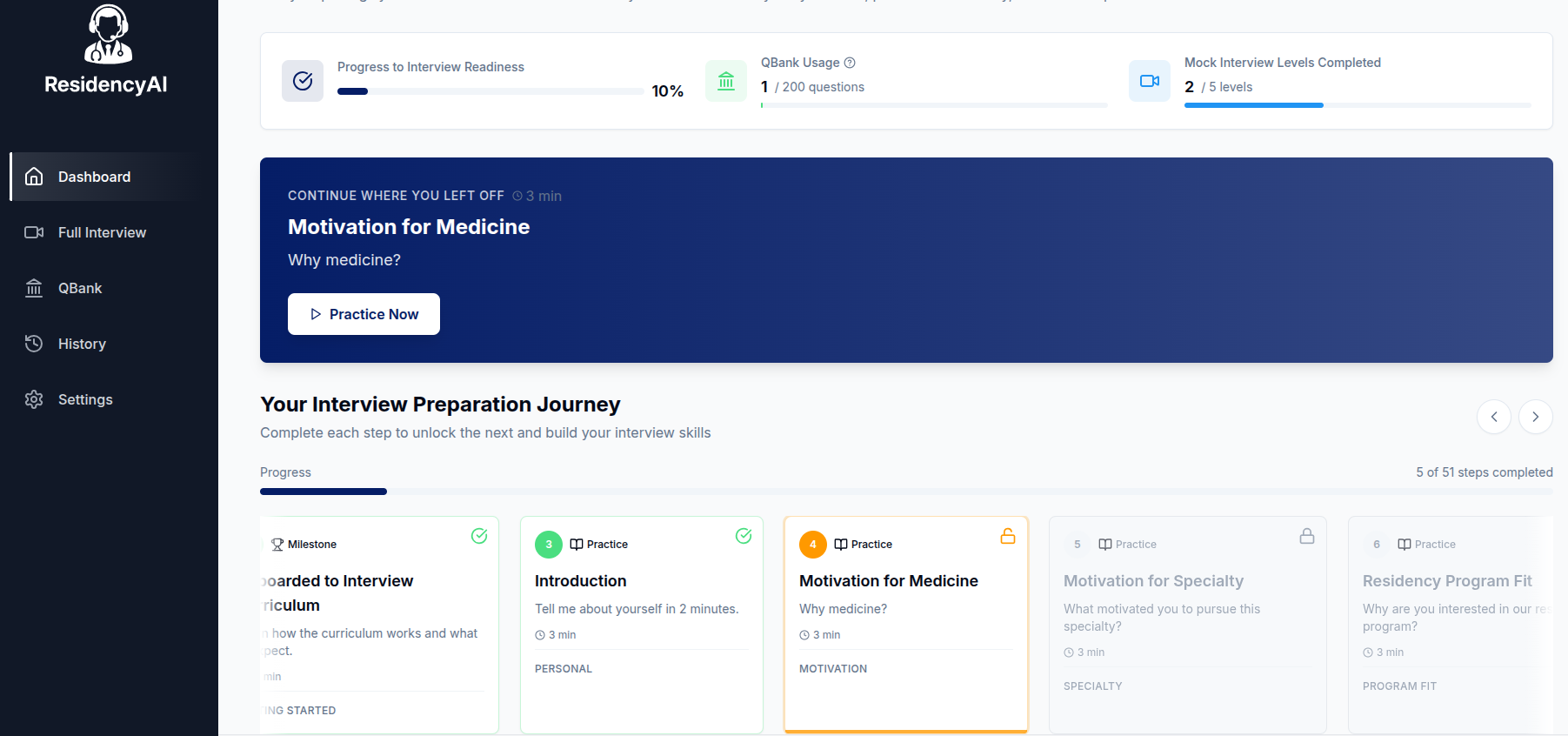
Deliberate practice is what separates applicants — reading sample questions isn't rehearsing. ResidencyAI lets you drill one tough prompt at a time, run a full mock interview, and get feedback on what you actually said. So "why osteopathic medicine?" sounds like you, not a template.
Want a feel for the format first? The AAMC's own MMI walkthrough is worth ten minutes.
Your DO application checklist
- 1–2 years out: Knock out prerequisites; shadow a DO and build that relationship; log clinical and service hours; keep records.
- ~10–12 months out: Study for and take the MCAT; research schools in the Choose DO Explorer; line up recommenders (science faculty + a DO).
- Spring (cycle opens May 4): Draft your osteopathic personal statement; request transcripts; release MCAT scores to AACOMAS.
- May–June: Submit AACOMAS as early as it's genuinely ready; confirm verification.
- July–August: Return secondaries within 1–2 weeks; take CASPer if required.
- September onward: Interview. Practice formats before invites arrive, not after.
- Through spring: Respond promptly to offers; withdraw from schools you won't attend before May 1.
Practice With ResidencyAI
You control the early stuff: grades, hours, essays. The interview is where a strong file becomes an acceptance — and it's the one stage you can't cram the night before.
ResidencyAI is built for exactly this:
Ready to practice your interview skills?
Try AI-powered mock interviews and get instant, actionable feedback.
- Single-question drills for your weak spots.
- Full mock interviews that help you rehearse a complete interview from start to finish.
- Personal statement review that catches generic "why osteopathic" framing before a committee does.
- Personalized questions generated from your personal statement and story.
Start practicing before the invite arrives — join ResidencyAI and walk into your DO interview ready to sound like yourself.