Questions to Ask During Your Medical School Interview
Table of contents
- How to Use This Guide: A 4-Step Framework
- Who to Ask What
- Curriculum & Teaching Style
- Clinical Exposure & Clerkships
- Wellness, Support & Advising
- Culture & Fit
- Research, Extracurriculars & Career Development
- What to Ask Current Students
- Smart Phrasing
- Pitfalls to Avoid
- After the Interview: Questions for Yourself
- Sample Questions Reference Table
- Practice With ResidencyAI
- Why It Works
- Read Also
You already know medical school interviews are a test. What most applicants forget is that they're also your test of the school. When an interviewer says, "So, what questions do you have for us?" — that's your best chance to figure out whether this is where you want to spend the next four years. Strong medical school interview preparation means arriving with sharp questions that go beyond what any website could tell you. The thesis of this guide: don't ask what's on the website — probe deeper.
The AAMC is explicit that the interview is a mutual evaluation — Sunny Nakae, then assistant dean for admissions at Loyola Stritch, calls it "a two-way street." The AACOM echoes this for DO applicants, urging them to research each college and "ask college-specific questions." Asking nothing — or asking something Google would answer — signals disinterest. Asking the right things signals fit.
Quick answer — 8 questions to steal right now:
- "How many hours per week are lecture vs. small-group or case-based work in year one?"
- "Are clerkships block-based, longitudinal, or a choice between them?"
- "Beyond a hotline, what does mental health support actually look like day to day?"
- "Would you describe the environment as more collaborative or more competitive — can you give an example?"
- "How do students find and fund research, and is time protected for it?"
- "What surprised you most after you started here — good and bad?" (ask a student)
- "How does the school live out its mission in ways I wouldn't see online?"
- "Knowing what you know now, would you choose this school again?" (ask a student)
Want the reasoning behind each — and how to personalize them? Keep reading.
How to Use This Guide: A 4-Step Framework
- Research first. Mine the AAMC's MSAR database and the school's mission statement, then ask about what you couldn't find. The AAMC is blunt: "Don't ask questions that can easily be answered on the school's website."
- Prioritize what affects your training — curriculum, clinical timing, and support systems shape your daily life far more than a campus photo.
- Personalize to your path. A rural-track applicant and a research-bound one shouldn't ask identical questions.
- Respect interviewer time. You'll usually get two or three questions, not twenty — pick your highest-yield ones.
Who to Ask What
| Topic | Best person | Example question | Why |
|---|---|---|---|
| Curriculum philosophy | Dean / Admissions | "How has the preclinical curriculum changed recently, and why?" | Leadership sets strategy |
| Mission & direction | Dean / Admissions | "Where do you see the school's biggest growth in the next five years?" | Only leadership can speak to vision |
| Research & mentorship | Faculty | "How do students typically connect with research mentors here?" | Faculty live the research day-to-day |
| Specialty exposure | Faculty | "How early do students get exposure to your specialty?" | Faculty know clinical pathways firsthand |
| Daily life & culture | Current students | "What surprised you most after you enrolled?" | Students give unfiltered ground truth |
| Support in practice | Current students | "When you struggled, who did you actually go to — did it help?" | Students know what really works |
MedEdits notes a typical interview day gives you access to all three — dean's talk, faculty interviews, then student lunch.
Curriculum & Teaching Style
Schools split between traditional lecture, problem-based learning (PBL) — small groups working patient cases, as at the Cleveland Clinic Lerner College of Medicine — and hybrids like Ohio State or Georgetown.
- "For a typical week in year one, how many hours are lecture vs. small-group work?" — shows if the pace fits your learning style.
- "How does the preclinical-to-clinical transition feel for students?" — this jump is where many struggle.
- "Is preclinical grading pass/fail, and what do students see about their standing?"
- "How is student feedback incorporated into curriculum changes?"
Tip: Naming a specific track works better than a generic ask — "Your PBL pathway is why I applied — how do students confirm it's the right fit for them?"
Clinical Exposure & Clerkships
The core divide: block rotations vs. the longitudinal integrated clerkship (LIC), where students follow patients across specialties at once — used school-wide at Washington State's Elson S. Floyd College of Medicine. Case Western lets students choose between the two.
- "Do students rotate through blocks, an LIC, or both — can students choose?"
- "How many clinical sites, and how much do patient populations differ?" — drives breadth of exposure.
- "At what point does hands-on patient contact start, not just shadowing?"
- "How do students get to affiliated sites — is a car required?" — a real budget/logistics question.
Tip: If a school places students in underserved settings, ask directly how that shapes training — KFF reports 26.7 million people under 65 were uninsured in 2024, so this is a live clinical reality, not a hypothetical.
Wellness, Support & Advising
Saint Louis University's "Mental Health 3.0" reform paired pass/fail grading with learning communities and saw measurably lower student depression and anxiety. A national survey of 27 medical schools in Academic Medicine found pass/fail preclinical grading at 74% and learning communities at 81% — so ask how robust a given school's version actually is.
- "Beyond a counseling number, what does support look like day to day?"
- "Is there one advisor who follows a student across all four years?"
- "What happens for a student who fails an exam or falls behind?"
- "Do learning communities or house systems exist, and are they active?"
Tip: Non-traditional applicants can get specific: "How does advising support students with dependents?"
Culture & Fit
The AACOM notes DO schools specifically seek "personal philosophy" alignment — the same fit test runs both ways.
- "Collaborative or competitive here — can you give a concrete example?"
- "How do students from different backgrounds describe feeling supported?"
- "What do students do for community outside of studying?"
- "How does the school live its mission in ways I wouldn't see online?"
Tip: Tie it to mission language directly — "Your mission emphasizes rural primary care, which is why I applied — how do like-minded students find each other here?"
Research, Extracurriculars & Career Development
The pool is small: per the AAMC, 702 MD-PhD students matriculated in 2025 out of 2,040 applicants — about 3% of the incoming class, most fully funded.
- "How do students fund research, and is protected time built in?"
- "What dual-degree options exist, and how do students add one?"
- "How do students explore specialties they didn't arrive knowing about?"
- "What does residency-application advising look like?"
Tip: To a faculty interviewer whose work you admire — "How do students typically get involved in labs like yours?" People like discussing their own work.
What to Ask Current Students
AACOM specifically recommends talking with students in advance — they're your least-filtered source. Stay professional; MedSchoolCoach warns "anyone could put in a bad word."
- "What surprised you most after you started — good and bad?"
- "On your hardest week, did the school's support actually show up?"
- "Are faculty reachable and responsive to student concerns?"
- "Knowing what you know now, would you choose this school again?"
Smart Phrasing
Wording signals your priorities without stating them outright:
- Primary care: "How does the school prepare students to care for underserved populations?"
- Rural medicine: "Do students get longitudinal placements in rural or community settings?"
- Research: "How do students protect research time during clinical years?"
- Ethics/policy: "Is bioethics woven throughout the curriculum or taught standalone?" (UW's Ethics in Medicine resource is a good primer here.)
Keep every question neutral — reveal your priorities, don't lead the interviewer.
Pitfalls to Avoid
- Website-answered questions — class size, tuition, deadlines are in the MSAR. Asking wastes your shot.
- Negative framing — "Isn't the pass rate low?" puts interviewers on the defensive. Reframe: "How does the school support Step 1/2 or COMLEX prep?"
- Rankings and prestige — reads as status-seeking, not fit-seeking.
- Asking nothing — the AAMC lists "do ask questions" as a core rule.
After the Interview: Questions for Yourself
- Fit: Could I thrive with these students for four years?
- Cost of living: Beyond tuition, can I afford life here?
- Support systems: Did the answers reassure me — or feel scripted?
- Gut check: Did I feel energized or drained walking out?
Follow the school's stated policy on thank-you notes — MedEdits notes practices vary by school.
Sample Questions Reference Table
| Category | Question |
|---|---|
| Curriculum | "How many hours per week are lecture vs. small-group work in year one?" |
| Clinical | "Are clerkships block-based, longitudinal, or a choice?" |
| Wellness | "Beyond a hotline, what does support look like day to day?" |
| Advising | "Does one advisor follow students across all four years?" |
| Culture | "Collaborative or competitive — can you give an example?" |
| Research | "How do students fund research, and is time protected?" |
| Career | "What does residency-application advising look like?" |
| Students | "Would you choose this school again?" |
For a visual walkthrough of the MMI format required by 31 U.S. and 13 Canadian schools, this Med School Insiders explainer is a clear primer.
Practice With ResidencyAI
Staring at 200+ questions can feel overwhelming, but consistent, feedback-driven practice turns quantity into confidence. ResidencyAI will act as your personal interview coach, available, to help you practice and refine your answers.
Ready to practice your interview skills?
Try AI-powered mock interviews and get instant, actionable feedback.
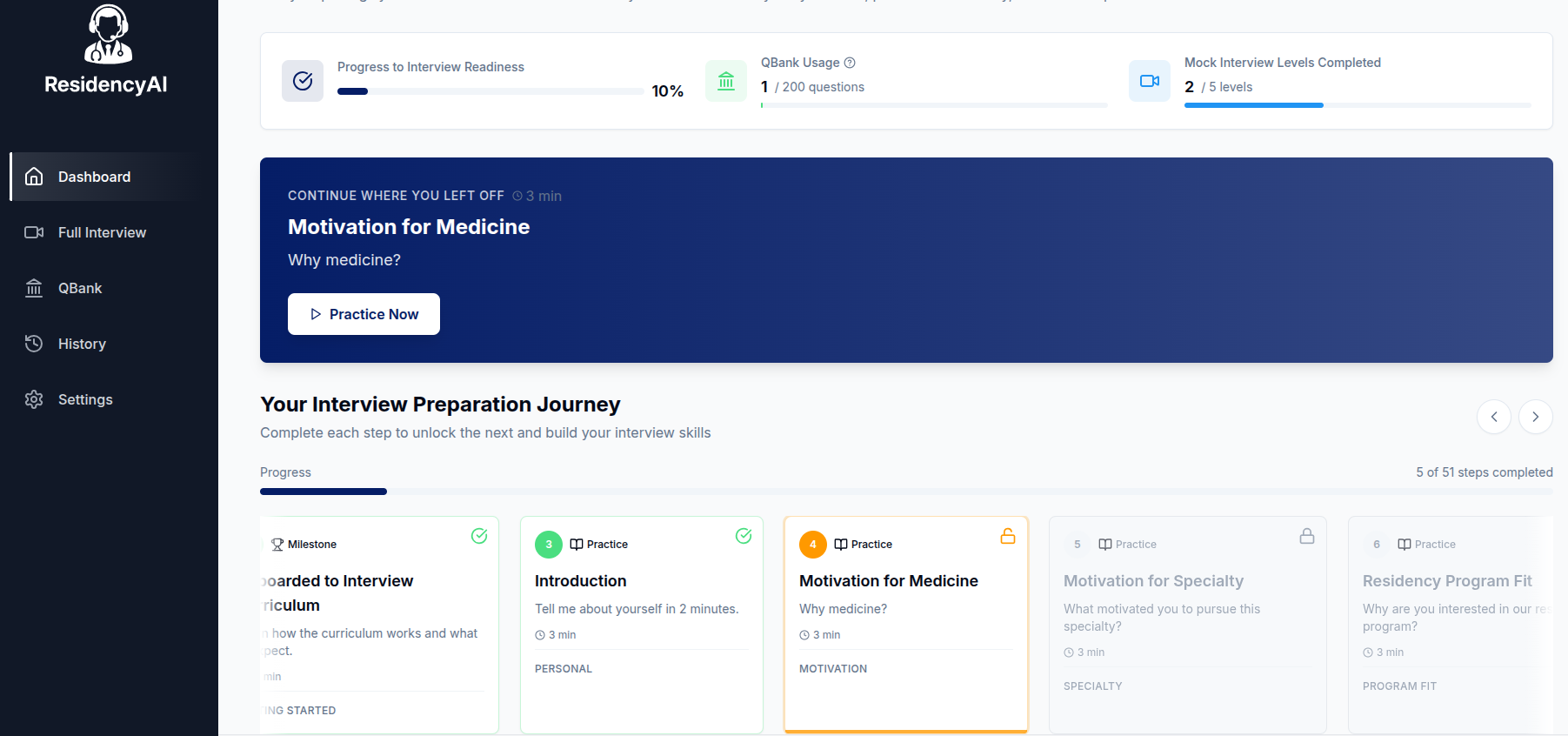
| Practice Mode | What It Looks Like | Why It Helps |
|---|---|---|
| Full Mock Interviews | Simulate a 20–30 minute session across a variety of interview scenarios. Find a quiet room and practice as if it were the real thing. | Builds stamina and confidence, and polishes your overall flow. |
| Single-Question Drills | Select any of 200+ questions from the Qbank and tackle them one at a time. | Lets you target weak spots or uncommon questions without running a full interview. |
| Personalized Questions | ResidencyAI reads your personal statement and generates interview questions tailored to your specific experiences and story. | Prepares you for the questions interviewers are most likely to ask which are specific to your application. |
Instant AI Feedback — After each answer, ResidencyAI provides personalized, detailed feedback so you know exactly what to improve.
Personal Statement Review — Beyond interviews, ResidencyAI reviews your personal statement, annotates it, and provides concrete ways to polish it.
Anytime Access — Practice at midnight or on the weekend; no need to coordinate with friends or faculty.
Why It Works
- Personalized analytics for every answer — overall feedback, strengths, areas for improvement.
- Personal statement–driven prep — your interview questions tailored to your personal statement.
- Progress tracking to monitor how ready you are ahead of your interviews.
- 24/7 availability for stress-free, on-demand practice — no scheduling, just practice whenever you want.
- Affordable price compared to other services.
Practicing with a friend or in front of the mirror can build some confidence — but ResidencyAI goes further: it reviews the personal statement that got you the interview, generates questions built specifically around it, and gives you detailed feedback on every answer. When interview day comes, you'll feel like you've been there, done that.