CaRMS Interview Guide: Format, Timeline, and How to Prepare
Table of contents
- What CaRMS Is (and Why the Interview Matters So Much)
- The 2027 R-1 Match Timeline
- How CaRMS Interviews Differ From ERAS
- Common CaRMS Interview Questions, Organized by CanMEDS
- How to Prepare: A Step-by-Step Plan
- Common CaRMS Interview Mistakes to Avoid
- FAQ: Quick Answers
- Practice With ResidencyAI
- Why It Works
- Read Also
If you are a Canadian or international medical graduate preparing for CaRMS interview season, this CaRMS interview guide is built to answer the three questions that keep applicants up at night: what the interviews are actually like, how the CaRMS timeline works, and how to prepare — including how CaRMS vs ERAS differs if you already know the U.S. system. The Canadian Resident Matching Service (CaRMS) runs the mandatory R-1 Main Residency Match that places graduating students, prior-year graduates, and international medical graduates (IMGs) into residency across Canada's medical schools. Strong CaRMS interview preparation is where good applicants separate themselves — so let's get you match-ready.
What CaRMS Is (and Why the Interview Matters So Much)
CaRMS is a national service that uses the Roth-Peranson algorithm to match applicants to residency programs, and the R-1 match runs in two iterations each year. Here's the 2026 snapshot in brief:
- 4,103 total R-1 positions offered in 2026, per CaRMS's official results release, with 3,922 filled — the highest-ever number of positions filled.
- 92.8% — current-year Canadian medical graduate (CMG) match rate in 2026.
- 87 current-year CMGs (2.9%) went unmatched after the second iteration.
- 931 IMGs matched in 2026, up from 851 in 2025 and 671 in 2024, per the same release.
The interview is often the last, most human filter in a process otherwise dominated by transcripts and reference letters — and it is where "good on paper" becomes "we want to work with you."
The 2027 R-1 Match Timeline
The table below reflects the 2027 R-1 Main Residency Match (first iteration) as published on the official CaRMS applicant timeline. CaRMS marks these dates "subject to change," so confirm them on carms.ca before relying on any single one.
| Milestone / Deadline | Date (2026–2027) |
|---|---|
| Registration opens | July 8, 2026, 12:00 noon ET |
| CaRMS Online opens for applicants; program descriptions available | September 9, 2026, 12:00 noon ET |
| Program selection opens | October 15, 2026, 12:00 noon ET |
| Transcripts & MSPRs sent by faculties | November 13, 2026 |
| Reference submission deadline | November 25, 2026, 21:00 ET |
| Application & document submission deadline | November 26, 2026, 12:00 noon ET |
| File review begins | November 26, 2026, 12:05 ET |
| Interview offer status updates complete | January 12, 2027 |
| National interview period | January 16 – February 7, 2027 |
| Ranking period begins | January 21, 2027, 12:00 noon ET |
| Applicant rank order list deadline | February 18, 2027, 15:00 ET |
| Match Day | March 2, 2027, 12:00 noon ET |
Two dates deserve special attention:
- Interview offer status updates complete: January 12, 2027. Per the CaRMS timeline, "official interview invitations must be distributed to applicants within five days of the interview status update" — meaning most invitations land in a tight window in mid-January.
- National interview period: January 16 – February 7, 2027. This window is short and applies to out-of-town current-year CMGs — you may have only a couple of weeks to interview across multiple programs.
How CaRMS Interviews Differ From ERAS
If you're cross-referencing against the U.S. ERAS process, four differences matter most:
-
Format variety is the norm, not the exception.
- Where ERAS interviews are largely conversational, CaRMS programs independently choose their format: one-on-one, panel (typically two to three interviewers), the Multiple Mini Interview (MMI) with five to eight timed stations, or the Modified Personal Interview (MPI).
- Programs also vary in file access — closed, semi-open, or open — which changes how much you need to surface your own highlights.
- Alberta's AIMG program notes that "candidates will be presented with eight stations (including one role-play station)... Each scenario or station is 9 minutes in total, with 2 minutes to review the scenario and 7 minutes to discuss the scenario with an interviewer," scored against the CanMEDS competencies.
-
Virtual is the default.
- Since the pandemic, CaRMS interviews are conducted virtually by most programs.
- This changes preparation: lighting, camera, a neutral background, and a backup plan for technical failures all become part of your performance.
-
The national interview period is compressed.
- Unlike the rolling ERAS interview season, CaRMS concentrates CMG interviews into a designated national window.
- IMGs and applicants interviewing at their own school are coordinated separately, with no fixed national period.
-
The MSPR and personal letter work differently.
- In CaRMS you write a separate, program-tailored personal letter (also called a personal statement) for each program, and your Medical Student Performance Record (MSPR) is submitted by your faculty.
Common CaRMS Interview Questions, Organized by CanMEDS
- Canadian programs assess candidates against the CanMEDS framework, the Royal College's physician competency model built on seven roles: Medical Expert, Communicator, Collaborator, Leader, Health Advocate, Scholar, and Professional.
- As the Royal College notes, "since its formal adoption by the Royal College in 1996, CanMEDS has become the most widely accepted and applied physician competency framework in the world" — and it is the scaffolding behind most CaRMS interview questions.
- Prepare one strong story per role, and you can pivot almost any behavioral prompt to material you've rehearsed.
Sample questions by role:
- Medical Expert / Scholar: "Tell us about a clinical case that challenged you." "What research question would you want to answer, and how would you design a study to answer it?"
- Communicator: "Describe a time you had to deliver difficult news or explain something complex to a patient."
- Collaborator: "Tell us about a time you worked in a team with conflicting opinions."
- Leader / Professional: "Tell us about a time you made a mistake — how did you handle it?" "How do you handle working with people in authority?"
- Health Advocate: "Describe a time you advocated for a patient or an underserved population."
- Professional / ethics: ethical scenarios grounded in the four principles of biomedical ethics — autonomy, beneficence, non-maleficence, and justice.
- Motivation & fit: "Tell me about yourself," "Why this specialty?", "Why our program?", and "What are your strengths and weaknesses?" remain near-universal.
Answer structure:
- Use a structured answer method such as STAR-L (Situation, Task, Action, Result, Lessons learned) — keep the setup brief and spend most of your time on the action, result, and reflection.
Prepare one story per CanMEDS role, then practice "pivoting" the same story to answer different questions. One well-chosen anecdote can cover leadership, collaboration, and professionalism at once.
Worth knowing:
- CaRMS's own interview guidelines tell programs to avoid questions about protected grounds — where you were born, your age, marital or family status, religion, or health.
- If you're asked something inappropriate, you can redirect gracefully to your qualifications.
How to Prepare: A Step-by-Step Plan
- Map each program's format early. As soon as you receive an invitation, confirm whether it's a panel, MMI, or MPI, and whether it's open- or closed-file. Build a simple spreadsheet so you prepare for the right format, not a generic one.
- Build your CanMEDS story bank. Brainstorm several impactful experiences from clerkship, research, and life, and map each to one or more roles. Journaling from clerkship is gold here.
- Research each program deeply. Read the program description, mission, and curriculum so your "Why us?" answer is specific. Prepare three or four thoughtful questions to ask them.
- Rehearse out loud, on camera. Record yourself, cap answers at 60–90 seconds, and watch the playback for pacing, filler words, and eye contact. Practicing on the actual video platform reduces anxiety.
- Do mock interviews with feedback. Simulated interviews with someone who can give honest criticism are the single highest-yield step.
- Nail your tech and environment. Test camera, mic, lighting, and connection; use a laptop rather than a phone; silence notifications; dress professionally head-to-toe; and keep the program's contact info handy in case of glitches.
Extra practice options:
- If you want reps beyond what a mentor's schedule allows, ResidencyAI's mock interview tool lets you practice on demand and receive instant feedback on your content and delivery, so you can walk into your interviews genuinely rehearsed.
- Work through the top 10 CaRMS residency interview questions and prepare to discuss the experiences in your CaRMS personal letter.
- You can also drill behavioral questions and build breadth using our extensive question bank.
Common CaRMS Interview Mistakes to Avoid
- Reciting a memorized script. Interviewers can tell, and it flattens the authenticity they're screening for. Know your stories, not your sentences.
- Vague, example-free answers. "I'm a strong communicator" means nothing without a specific story that shows it.
- Neglecting "Why this program?" Generic answers signal low interest, which programs weigh heavily.
- Trailing off. Structure answers with a clear beginning, middle, and end so you land your point instead of fading out.
- Panicking over a bad answer. If you misspeak, issue a calm "retraction" and correct yourself — the ability to self-correct is exactly what programs want in a trainee.
- Treating socials or downtime as off the record. Professionalism is assessed throughout.
- Discussing ranking intentions. Per CaRMS rules, neither you nor the program may signal how you'll rank each other; don't raise it.
- For IMGs specifically: don't underestimate how much programs probe your understanding of the Canadian healthcare system and your fit within it. Because IMGs face far lower match rates and apply to dozens of programs on average, adequate preparation for each format is essential.
FAQ: Quick Answers
How long is the CaRMS national interview period? For the 2027 R-1 Match, the national interview period runs January 16 – February 7, 2027, per the official CaRMS timeline. It applies to out-of-town current-year CMGs; IMGs and applicants interviewing at their home school are scheduled separately.
Are CaRMS interviews virtual or in person? Since the pandemic, most programs interview virtually by default, though this can vary by program and should be confirmed on your interview invitation.
What's the main difference between CaRMS and ERAS interviews? CaRMS programs independently choose from several formats — one-on-one, panel, MMI, or MPI — versus the more uniform, conversational format typical of ERAS interviews, and CaRMS concentrates most interviews into one compressed national window rather than a rolling season.
What framework do CaRMS interview questions map to? Most CaRMS interview questions are designed to probe the CanMEDS physician competency roles: Medical Expert, Communicator, Collaborator, Leader, Health Advocate, Scholar, and Professional.
How many programs do CaRMS applicants typically apply to? In the 2026 cycle, IMGs applied to an average of 43.3 programs in the first iteration versus 20.2 for CMGs, per CaRMS's data overview.
Practice With ResidencyAI
Staring at 200+ questions can feel overwhelming, but consistent, feedback-driven practice turns quantity into confidence. ResidencyAI will act as your personal interview coach, available, to help you practice and refine your answers.
Ready to practice your interview skills?
Try AI-powered mock interviews and get instant, actionable feedback.
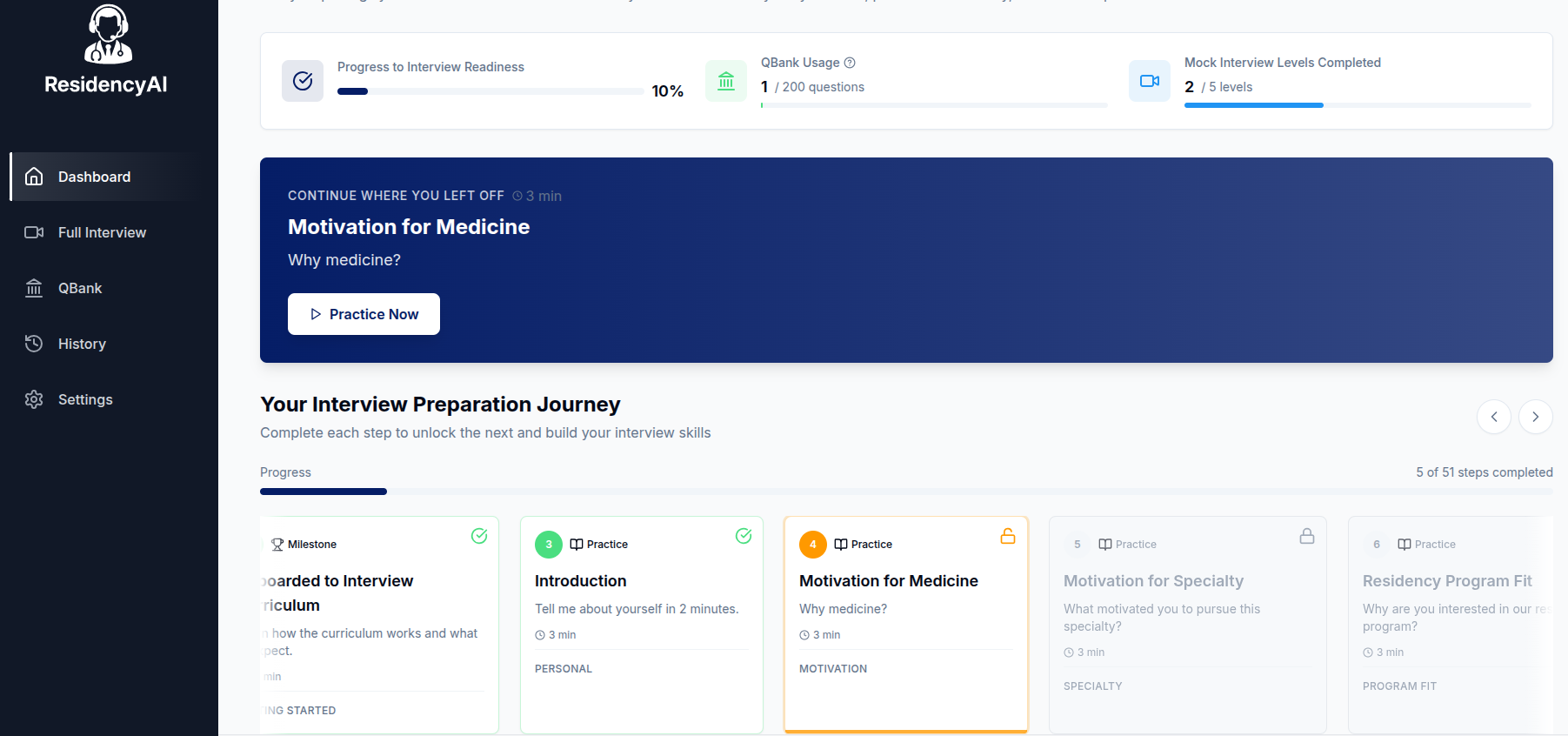
| Practice Mode | What It Looks Like | Why It Helps |
|---|---|---|
| Full Mock Interviews | Simulate a 20–30 minute session across a variety of interview scenarios. Find a quiet room and practice as if it were the real thing. | Builds stamina and confidence, and polishes your overall flow. |
| Single-Question Drills | Select any of 200+ questions from the Qbank and tackle them one at a time. | Lets you target weak spots or uncommon questions without running a full interview. |
| Personalized Questions | ResidencyAI reads your personal statement and generates interview questions tailored to your specific experiences and story. | Prepares you for the questions interviewers are most likely to ask which are specific to your application. |
Instant AI Feedback — After each answer, ResidencyAI provides personalized, detailed feedback so you know exactly what to improve.
Personal Statement Review — Beyond interviews, ResidencyAI reviews your personal statement, annotates it, and provides concrete ways to polish it.
Anytime Access — Practice at midnight or between rounds; no need to coordinate with friends or faculty.
Why It Works
- Personalized analytics for every answer — overall feedback, strengths, areas for improvement.
- Personal statement–driven prep — your interview questions tailored to your personal statement.
- Progress tracking to monitor how ready you are ahead of your interviews.
- 24/7 availability for stress-free, on-demand practice — no scheduling, just practice whenever you want.
- Affordable price compared to other services.
Practicing with a friend or in front of the mirror can build some confidence — but ResidencyAI goes further: it reviews the personal statement that got you the interview, generates questions built specifically around it, and gives you detailed feedback on every answer. When interview day comes, you'll feel like you've been there, done that.